
A B2B SEO strategy is a decision about which pages a site will have, in what order they get built, how they link to each other, and what number proves they worked. Most of what’s published under the term is a content plan with a technical checklist attached, and that is why most B2B sites end up as Homepage + Product + Blog: the strategy never decided what the pages in between should be, so they never got built.
The buyer is a buying committee: six to ten people on Gartner’s count, thirteen internal stakeholders plus nine outside influencers in Forrester’s State of Business Buying 2026, the gap being what each firm counts as a stakeholder. They search for different things at different stages. The queries are low-volume and high-value: 50 searches a month from people with budget beat 50,000 from students. The cycle is long, 10.1 months on average in 6sense’s 2025 Buyer Experience Report, so a ranking won shows in the pipeline two or three quarters later. And most of the market isn’t buying: Ehrenberg-Bass with the LinkedIn B2B Institute puts in-market buyers at about 5% at any moment, and TrustRadius’s 2026 B2B Buying Disconnect found 79% of buyers had heard of the product they bought before formal research started. The site’s job in search is less to be discovered than to be confirmed: to be there, with the right page, when the 5% check.
B2B SEO vs B2C SEO in four rows
B2B SEO and B2C SEO use the same disciplines, pages, links and technical health, pointed at different questions. B2C asks how many people arrived. B2B asks whether the ones who arrived can sign a contract.
| B2B SEO | B2C SEO | |
|---|---|---|
| Who searches | a committee of 6–13 roles, each with its own query | one person, who also pays |
| Query volume | tens to hundreds a month, often below the keyword tools’ floor | thousands to millions |
| Time from ranking to result | a 10-month deal cycle on top of ranking time | same session to a few days |
| What proves it worked | opportunities and closed-won by page template | sessions, orders, revenue per visit |
The first decision below is the one the others depend on, and it’s the one most B2B SEO plans never make. This is the plan for a site; what to do with a site that already exists and underperforms is the B2B SEO audit, and the two share a vocabulary on purpose.
Step 1. Decide the site’s centre before adding pages
A B2B SEO strategy starts with the site’s centre, because every page a site publishes either sits near what the site is about or pulls away from it, and a site with a clear centre ranks for the queries around that centre more easily than a site that covers everything a little. Topical authority is the usual name for this, and it usually stays a word. I measure it. Each page gets a position in meaning relative to the site’s densest cluster, and two numbers come out: site focus, the median closeness of pages to that centre, and site radius, the spread. On our own site the densest cluster is the Insights section, twelve pages, and sixteen pages are scored against it: eleven on topic, four nearby, one drifting. Focus reads 0.90, radius 0.05.
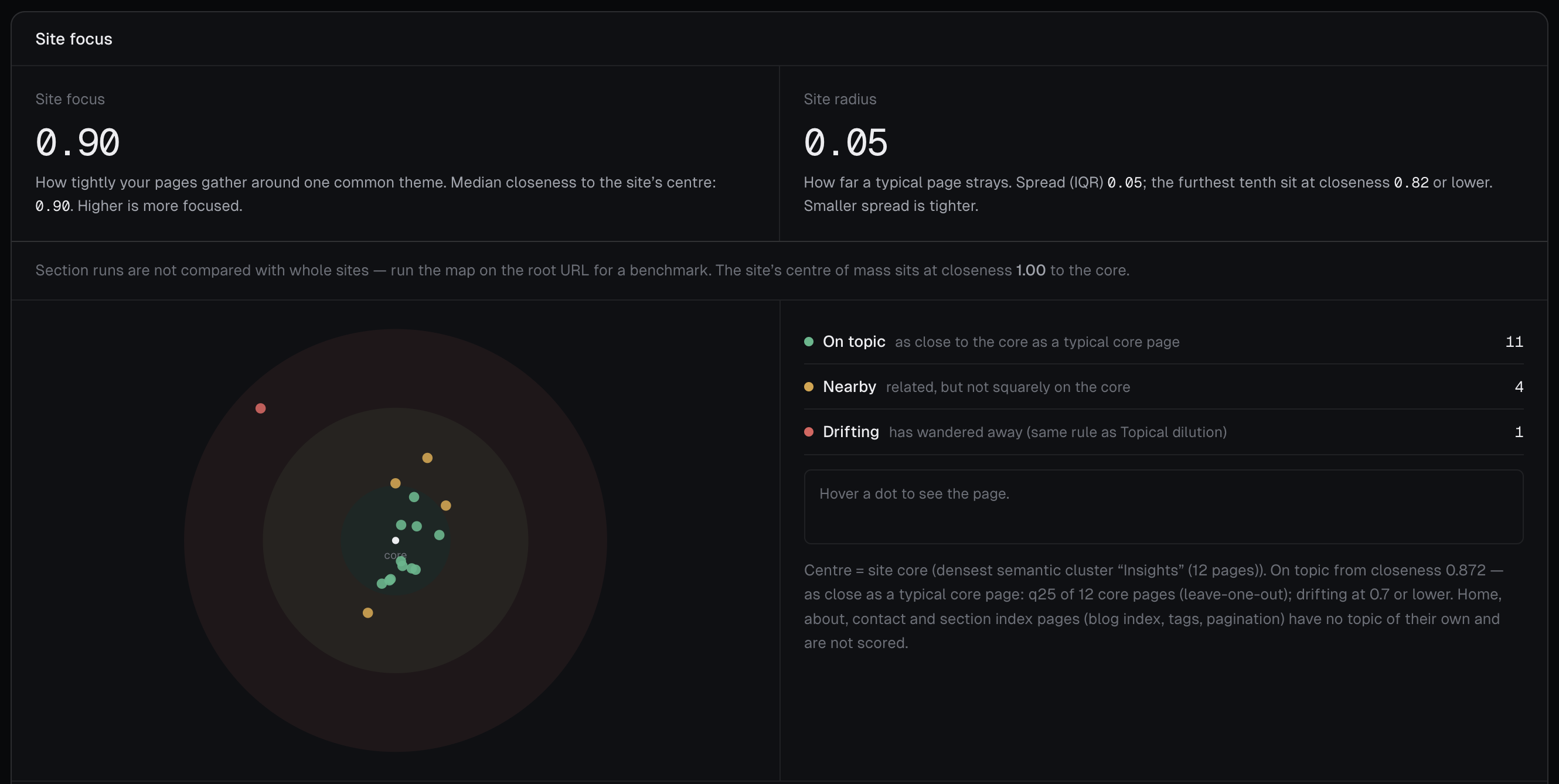
The thresholds do the work. “On topic” is set by the core itself: a page counts as on topic when it sits as close to the centre as a typical core page does, which on this site is 0.872, so three of the twelve core pages land in “nearby” by their own cluster’s standard. A page scores drifting at 0.7. Home, about, contact and the section index pages are left out, because they describe the company and have no topic of their own, and a section run is never compared with a whole-site run, because a twelve-page folder will always look tighter than a 400-page domain.
Two things this number is not. It isn’t Google’s: the 2024 leak listed fields with similar names, and nobody outside Google knows how or whether they’re used, so this is our model of focus, built to make a decision with. And it is applied before a page exists, to every page proposed: a use-case page, an integration page, a comparison lands inside the core, because they are about the same thing the solution pages are about; a blog post on a trend in an adjacent industry lands outside it. Written before the plan, the centre decides which of the two hundred keyword ideas become pages, and which get written down and never scheduled.
Step 2. Map the B2B buying committee to a demand ladder
Funnel diagrams have the stages right and the pages missing. B2B demand runs down a ladder from the problem to the price, and each rung is searched by a different seat on the committee. The ladder below is built for a warehouse-management vendor as the example; the rungs hold for most B2B categories, the queries change.
| Rung | Example query | Stage | Who searches it | Page template |
|---|---|---|---|---|
| Problem / industry | “3PL inventory accuracy” | research | operations manager | guide, industry page |
| Solution | “warehouse management software” | research | manager | solution page |
| Use-case | “WMS for cold storage” | evaluation | manager, end user | use-case page |
| Integration | “WMS Shopify integration” | evaluation | engineer | integration page, docs |
| Security | “[vendor] SOC 2”, “[category] software GDPR compliant” | evaluation | security lead | trust center |
| Comparison | “[vendor] vs Manhattan”, “Manhattan alternatives” | decision | procurement, manager | comparison, alternatives page |
| Pricing | “warehouse management software pricing” | decision | procurement, finance | pricing page |
A buyer doesn’t walk the ladder once. They come back to the topic five or ten times over a quarter with a different question each time, which is why each rung needs its own page; one article per keyword covers one rung and leaves the rest of the committee with nothing. A site built as Homepage + Product + Blog covers the solution rung and the problem rung and nothing between, which is where evaluation-stage buyers search and where the engineer and the security lead search at all. For a SaaS product the ladder adds two rungs, free trial and documentation, and the same rule holds. The first output of a B2B SEO strategy is this table filled in for your category: which rungs have demand, which seats search them, and which template answers each. Most rungs are two to ten pages; the integration rung on a product with twelve integrations is twelve pages.
Step 3. B2B keyword research when the tools show zero
B2B keyword research has one problem the consumer version doesn’t: the queries that matter return 0 or “n/a” in Semrush and Ahrefs, because a few dozen searches a month sits under the tools’ floor, and the long-tail estimates for what does show are noisy. Search Console on the existing site fixes half of it, since every query with an impression there is real, including the ones the tools never saw; the brand regex split comes first, because a site whose organic is 80% brand is reading its own name back. The other half comes from where committee members ask when Google gives them nothing: the questions under YouTube videos on the topic, Reddit threads in the practitioner subreddits, the prompts people put to Perplexity, Amazon’s autocomplete for the hardware side of the category, and the sales team’s call recordings, where the buyer’s own phrasing is on tape. We pull from fourteen sources for this reason, and on a narrow B2B category about half the useful phrasings come from outside Google.
Intent sorting (informational, commercial, transactional, navigational) is a label on each query, and it’s useful for assigning a rung. It is not how queries get grouped into pages. Cluster by what the SERP does, the method in what to do after keyword research: two queries belong to one page when Google returns the same results for them, and to two pages when it doesn’t, whatever the head term. “SEO audit cost” and “SEO audit checklist” share a head term and get different result pages; “what does an SEO audit include” and “SEO audit checklist” share no words and get the same one. Stem-based grouping gets both wrong. The clusters map to the ladder in Step 2, one cluster per rung per template, and the leftover clusters, the ones that fit no rung, are the ones Step 1 says not to build.
Step 4. Specify the page templates a B2B site needs
This is the step that decides whether the site converts, and it’s the one “create helpful content” stands in for. A B2B marketing site is five or six templates, and the B2B SEO strategy writes a specification for each: the blocks the pages ranking for that rung carry, which is parity, and the one or two things only your page will carry, which is the reason to pick you.
| Template | Blocks the top five carry | What only yours carries |
|---|---|---|
| Solution / service page | The problem in the buyer’s words; the method as numbered steps; timeline; what the deliverable looks like; named people; proof (cases, logos, numbers); price or a range; FAQ | Your own method, named; your own metric; a named person with a photo; access to something competitors don’t give |
| Use-case / industry page | The industry’s version of the problem; which features matter here; a case from this industry; integrations this industry runs | A number from your own clients in this industry |
| Integration page | What syncs, in which direction, how often; setup steps; limits; a link to the docs | The limits, honestly stated; the docs themselves |
| Comparison / alternatives | A feature table that gives the competitor its strengths; pricing side by side; who each one suits; migration effort | “When to choose them instead,” written so a buyer believes the rest |
| Pricing page | Tiers or a range; what moves the price; what’s included; a path to a quote that isn’t a form wall | A true-cost breakdown including the fees others hide |
| Trust center | Certifications with dates; sub-processors; where to send the questionnaire | The questionnaire already answered |
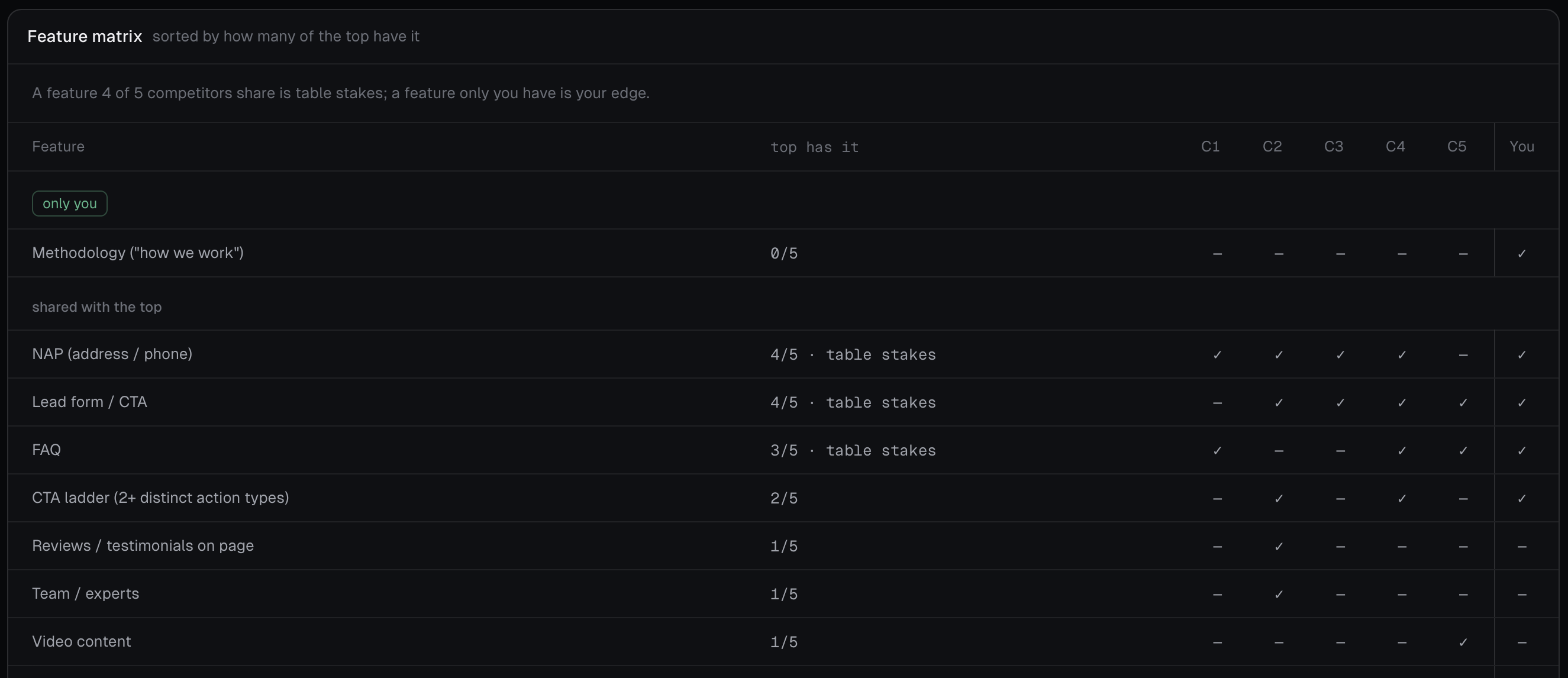
The “blocks the top five carry” column is read off the SERP. We run the five pages ranking for a service query through a feature matrix, and the run below is typical of what comes back: a lead form and the company’s contact details on four of the five, a FAQ on three, a second call to action on two, a named team on one, reviews on the page on one, and a description of how the work is done on none. The counts move by one from category to category. The empty methodology row doesn’t.
The solution page row is where the most money is lost, because most B2B service pages are written the same way: “a team of professionals,” “quality and value,” three icons, a form. Pages written like that fail twice. They rank badly, because against ten pages saying the same thing Google has no reason to prefer one, and they convert badly, because a buyer comparing three shortlisted vendors who all say the same thing chooses on price, or on whoever called back first. The service page that wins is written as a landing page, through the problem and the method: here is what you’re dealing with, here is how we do it in order, here is who does it, here is what you get and what it costs. In TrustRadius’s 2026 survey, 63% of buyers used AI somewhere in the purchase and 94% of those fact-checked what it told them; the place they check is the vendor’s page, and a page with nothing checkable on it fails that check.
A real person on every template
One rule runs through every template on a B2B site. The author on the articles and the manager on the service page are the same named human, with a real photo, a bio that says what they’ve done, and Person markup with a sameAs pointing at their LinkedIn, on every page they appear on. We do this on our own site, and it’s read two ways at once. Google’s guidance on helpful content asks who wrote the page and what they know; the markup is how the name becomes an entity the systems can resolve rather than a byline string. And the CTO on the committee sees who answers for the work. Whether the AI engines prefer a page with a named author to one signed by “Admin” I can’t show from our own data yet; what I can show is that a site which uses one person consistently across its articles and its service pages has built an entity, and a site with a different stock photo on each page has built nothing.
Technical SEO requirements by template
Technical SEO for a B2B site is a per-template requirement written before the pages exist: what each template must render in the server HTML, which Core Web Vitals threshold it has to pass, which schema it carries, and which fields a marketer can edit without a ticket.
| Template | Must be in server HTML | Core Web Vitals | Schema |
|---|---|---|---|
| Solution / pricing | price or range, method steps, named person; the tier table, not a JS widget | INP ≤ 200 ms, LCP ≤ 2.5 s on mobile field data | Organization, Service or Product, Person |
| Comparison / alternatives | the feature table and the “when to choose them” block | same thresholds; tables are rarely the problem, embedded calculators are | Article; FAQ only if the FAQ carries answers the body doesn’t |
| Integration / trust center | sync direction and limits; certification dates; nothing behind a tab that loads on click | same | Article; Organization with sameAs to G2, Crunchbase, LinkedIn |
| Gated asset | an indexable summary page with the same title, the gate on a separate URL | same | Article |
The thresholds are Google’s: INP replaced FID as the responsiveness metric in March 2024, and “good” is 200 milliseconds. The rendering rule is ours, from sites where the pricing page rendered after JavaScript and the blog ranked instead. Those decisions and the acceptance table that enforces them are in the web development and SEO guide; a B2B SEO strategy that leaves them to the developers gets a site that ranks the blog and serves an empty <div> where the price should be.
Step 5. Order the build by distance to the pipeline
Volume sets the order in most B2B SEO plans, so the biggest informational cluster gets written first, needs a year, and the quarter ends with nothing in the pipeline. Distance to revenue sets it instead. The decision rungs come first: comparison, alternatives and pricing pages, because the 5% who are in-market search those now, they’re short to build, and the SERPs for them are weak, since most vendors won’t write a comparison that gives the competitor credit. Then the evaluation rungs, use-case, integration, trust center, which carry the committee seats the site currently ignores. Then the solution pages, rewritten against their template. The blog last, and only the clusters inside the core from Step 1, with a production rule attached: each post has to carry something the pages already ranking for its query don’t, and the cheapest reliable source of that is fifteen minutes with the engineer, the architect or the product manager who does the work, recorded and written up from their words. A generalist copywriter working from a brief produces the tenth restatement of the top ten; the interview produces the one thing in the post that isn’t already in the index. Paid search and ABM sequences land on the same templates, and they convert the way the template converts, so neither is a reason to reorder.
If the site already exists, there’s a step zero: the striking-distance pages, anything at positions 5 to 20 on queries with impressions, which a block and an internal link move in weeks. A content audit sorts the blog into piles for this. On a 24-article journal we ran the audit on, fifteen graded strong, five needed depth or an author, three needed a rewrite, one was a merge, and two carried an AI score above 60% and went to a human to read. The five in the middle are step zero: pages that already have impressions and a grade one block away from strong.
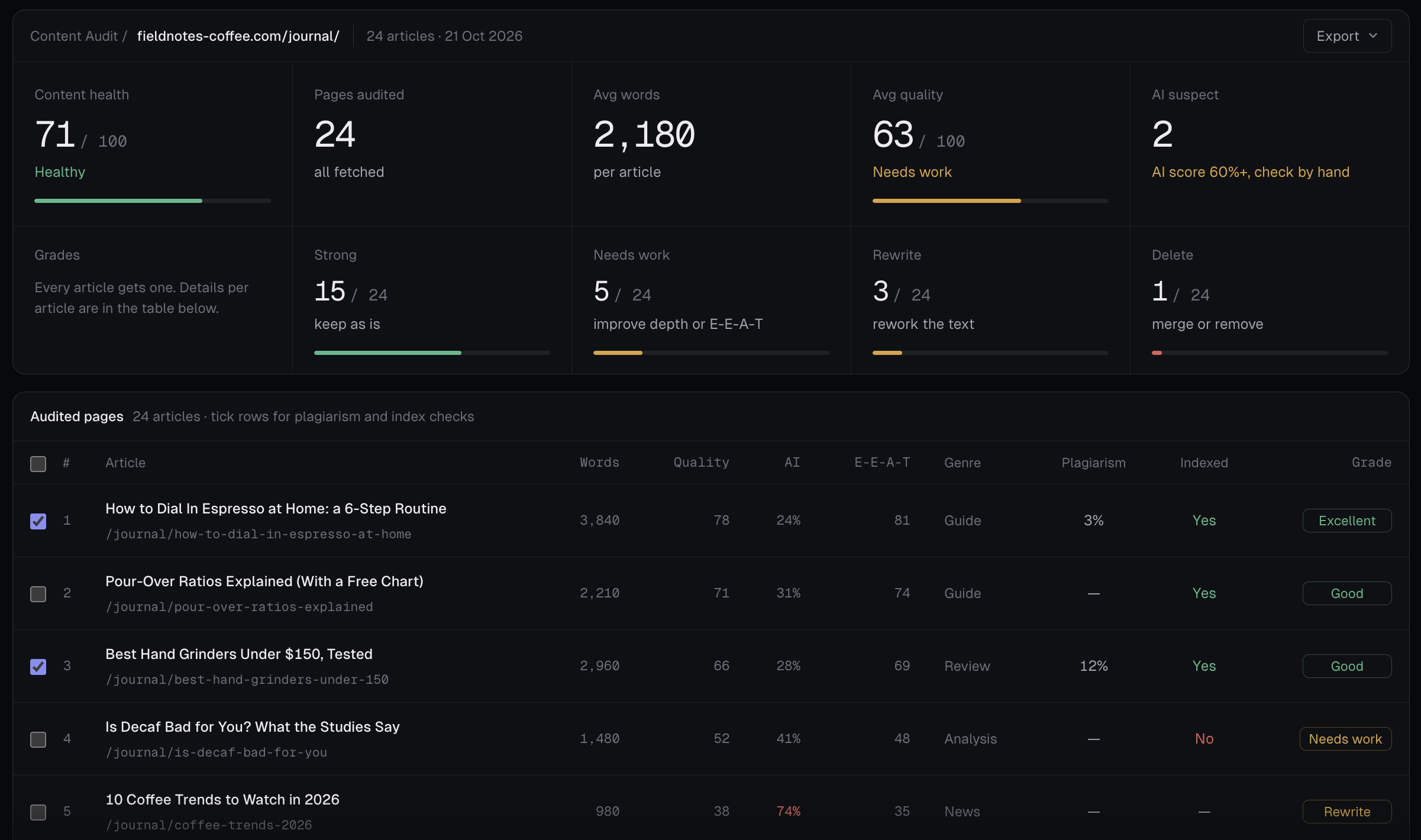
Step zero comes before any new page, because it’s the only thing in the plan that produces a result inside the first quarter.
Step 6. Link so that pages inherit authority
On a B2B site a page doesn’t carry topical authority on its own. It inherits it from the cluster it sits in: what links to it, with which anchors, and what it links out to. Authority also pools where the links point, and on most B2B sites it pools in the blog, because the blog is what the team links to by habit, while the solution pages that carry the revenue get their inlinks from the footer and the nav and nothing from the body of any article. The strategy fixes that with four rules.
- Every article links to one commercial page, in the body, where the reader is ready to ask for the service, with the page’s primary term or a plain phrase as the anchor, never “learn more.”
- Every article links to one sibling in its cluster and up to its pillar.
- Every commercial page links to the two or three articles that answer the question a buyer has before the form. This is the direction that goes unbuilt, because service pages are written by a different team from the blog.
- The metric is inlinks per template divided by revenue per template, read quarterly. If the blog is at the top and the solution pages at the bottom, the rules aren’t being followed.
Step 7. B2B link building, in the order that reads as a real company
B2B link building starts with a base package that makes the domain legible as a company, continues with pages built to earn links, and keeps the anchor profile and the monthly rate inside the ranges a natural profile shows.
The first mistake is aiming at the sales team’s competitor list instead of the search competitors, the domains that outrank you on the terms that matter, which on a typical B2B SERP are a review platform, a publisher and one vendor sales has never heard of. The second is anchors, and a profile reads that one off in a minute. One Ahrefs export we put through the backlink report, 1,284 links from 377 referring domains, had exact-match anchors at 18% against a natural range of 1–10%, branded anchors at 22% against 25–60%, 3.4 links per referring domain against 1.5–2.5, and a June 2026 month with 96 new links, one and a half times the average. Three commercial URLs carried mostly money anchors. Only twelve links, under 1%, were toxic by anchor text. The report flags shape; it doesn’t know whether the domain ranks, and a profile like this can sit on a site that ranks fine until a manual review or a spam update reads the same shape. That is why the Search Console read in Step 9 goes next to it.
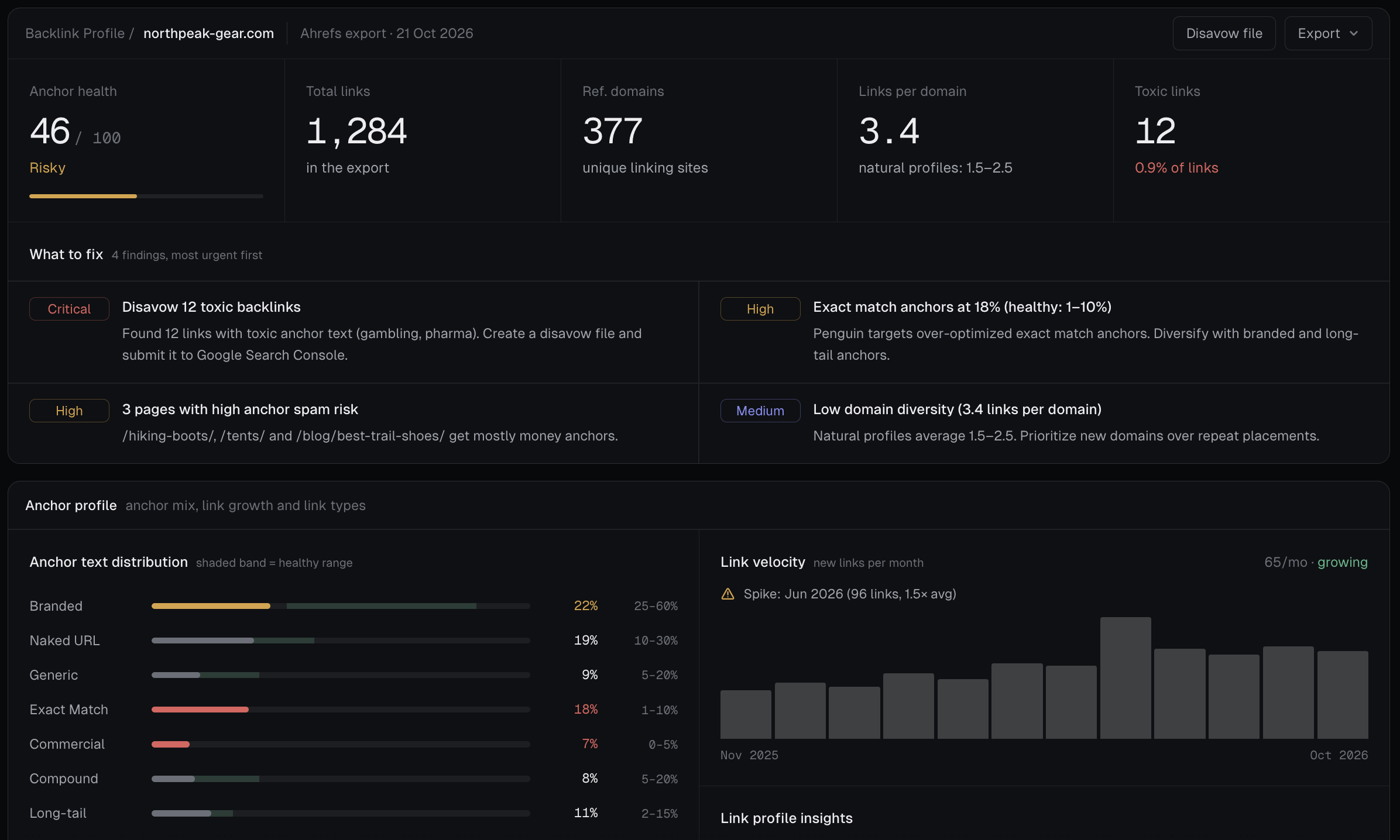
For a new B2B site the base is small and dull: directory and profile listings on the surfaces the committee uses (G2, Capterra, Crunchbase, LinkedIn), a press release for the launch, social profiles with the same description as the site, and two or three guest posts on topical sites with the company name as the anchor. That is the package that gets a domain read as a real company, and it’s the branded 25–60% in the band above. After it, links come from the pages that earn them, and no month runs at one and a half times the average, which is what the June spike looks like from outside.
Step 8. B2B SEO for AI answers: pages and entity consistency
A B2B buyer now asks ChatGPT, Perplexity or Google’s AI Mode before touching a vendor site. How many depends on the survey and the question asked: 63% used AI somewhere in the purchase in TrustRadius’s 2026 report; 51% start their research in an AI tool in G2’s 2026 Buyer Behavior Report; 94% of buyers on $25K+ deals used an LLM at some point in 6sense’s 2025 study. The clicks are moving the other way.
Position 1 with an AI Overview above it: −58% click-through against the same keywords in December 2023. Position 10: −19%. Ahrefs, 300,000 keywords, December 2023 vs December 2025, published February 2026.
A B2B SEO strategy can plan for one thing here: being in the answers. Two levers decide it. The pages: an engine answering “best WMS for cold storage” breaks the question into sub-questions, which Google’s AI Mode documentation calls query fan-out, integrations, compliance, pricing model, migration, and cites pages that answer each one in a self-contained block. That is the template specification in Step 4; nothing new gets written for the engines. And the entity: the engine’s picture of the company comes from G2, Capterra, Crunchbase, LinkedIn and Wikidata as much as from the site, so four fields have to match across every surface: the category name, the one-line description, the founding year, and the product names. The listing that was set up once and never opened again is where they stop matching.
Step 9. Measure B2B SEO in pipeline, quarterly
Sessions and rankings are inputs. The number a B2B SEO strategy is judged by is opportunities created per page template, read from GA4’s landing page joined to the CRM’s source field on the opportunity record, and read quarterly, because the deal cycle is most of a year and a monthly read is noise. The join is three fields: landing page on the first session, source on the contact, and the opportunity the contact is attached to. If it doesn’t exist, no UTM discipline, no source field, building it is the first item in the plan, ahead of any page, because without it the plan can’t be judged.
What I don’t have is a number for how many B2B marketing teams read this join at all. The surveys ask about “pipeline contribution” as a KPI, which is a different question from whether the data exists; in the sites we’ve taken on, the join was the exception at the start, and the rest were reading sessions.
The chain the join has to carry runs organic session → SQL → opportunity → closed won, and the last link is the one that reorders the plan: a cluster that produces SQLs and no closed deals is attracting a seat that can’t sign, and the budget moves to the cluster that closes.
The quarterly B2B SEO read is four lines:
- Opportunities and closed-won by template, against the build order in Step 5.
- Share of answers: on how many of the fan-out sub-questions from Step 8 the company is cited, against the same list each quarter.
- Impressions and clicks per cluster in Search Console, the cluster as one object, because a single article’s line is noise for two months; and the SERP for each cluster re-read in the same pass, because a guide slides when the results turn into comparisons or product pages, and Search Console won’t say why.
- Focus and radius from Step 1, re-run, to catch the drift before it accumulates.
Rankings come last, and brand against non-brand every time.
How long B2B SEO takes, by where the site starts
How long B2B SEO takes depends on the site’s history more than on the plan. A single number averages three different cases.
A new site launched right. Service pages built to their templates, a named person on them, the blog written inside the core with the links from Step 6, and the base link package from Step 7, with nothing bought. On that start the site begins picking up low-volume, non-brand impressions around month three, and the first opportunities arrive in the second or third quarter, since the deal cycle sits on top of the ranking time.
An old site with a history. This is the case where the plan can stall at position 50 for a year with no single cause to point at. Redirect chains from two migrations, a link run from 2019 through a layer of throwaway domains, an anchor profile like the one in Step 7, a blog of templated posts written per keyword with no author: each of these is a reason Google keeps the site where it is. The helpful content system was launched in August 2022 as a site-wide signal and folded into the core ranking systems in March 2024, so the templated blog pulls down the service pages that were rebuilt properly. The plan for a site like that starts with a B2B SEO audit, because the first quarter is cleanup, merges, 301s and deletions, and the templates from Step 4 go live into a domain that’s been given a reason to be re-read.
An old site that’s merely thin. No history to clean, just pages that say nothing: service pages with icons, a blog nobody links to. The template rewrites in Step 4 land on a site Google already crawls, and the step-zero pages move inside the first quarter. The blog audit from Step 5 is what tells the second case from the third: a journal where most posts grade strong and a few need depth is the third case; a journal where a third grade “rewrite” and the AI-suspect count runs into double digits is the second, whatever the backlink profile says.
B2B SEO strategy FAQ
How many pages does a B2B site need?
There’s no threshold, and nobody has shown one. As a plan size, a narrow B2B category usually closes its core in 15 to 30 pages across the templates in Step 4 plus a blog inside the centre; a broad category runs 50 to 150, in clusters of one pillar and ten to fifteen supporting pages. Those are what it takes to cover the ladder, not a number after which something switches on.
What’s the difference between a B2B SEO strategy and a B2B SEO audit?
A B2B SEO strategy decides what to build and in what order. A B2B SEO audit reads a site that exists and finds where traffic stops turning into opportunities. On a site with history, the audit comes first and the strategy is its roadmap.
One test for whichever plan you end up with. If the site received 30% less traffic next quarter but every visitor were a decision-maker with a budget, would the plan change? If the answer is yes, the current B2B SEO plan is still built for traffic. The strategy described here is what our SEO service produces in the first month of an engagement, before any page is written.