Link Equity & Toxicity
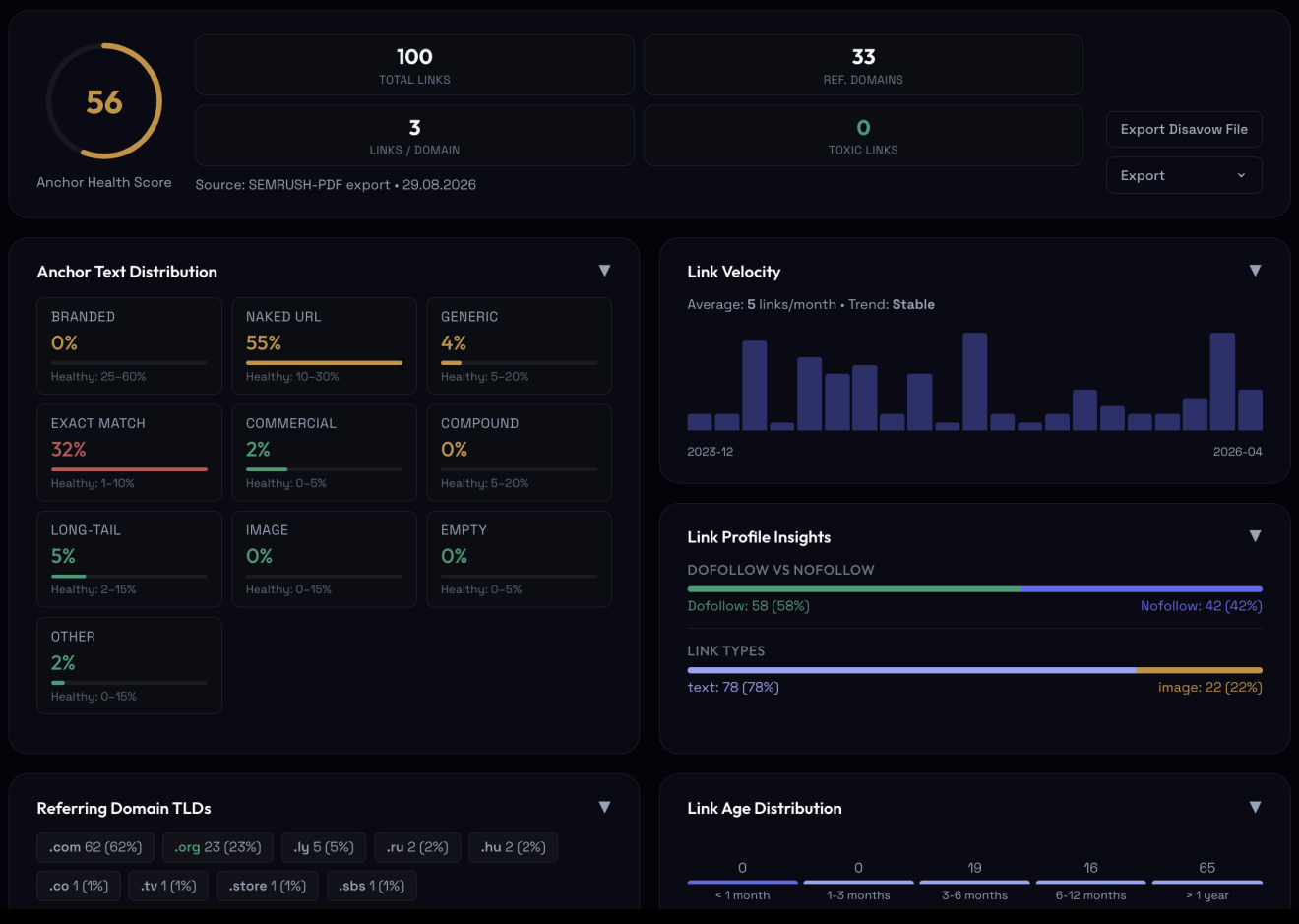
B2B link profiles are full of guest posts that carry nothing. The off-page audit isolates which links bring authority and whether any of it reaches the pages that make revenue.
What you see
- Where authority is stuck, and how to move it. Solution pages starved of internal links, each paired with the high-authority posts that should link to them. A named list, with the anchor suggested.
- The guest posts that never paid off. Placements carrying the signals Google discounts: paid-post hubs, off-niche sites, network footprints. Each with the evidence.
- An anchor profile that survives a manual review. Over-optimised anchors and toxic patterns caught, with a disavow file reasoned per domain.
The disavow file ships with a one-line reason per domain, so you can overrule any of them.
Semantic Site Map & Blog Triage
Years of consistent publishing usually means five articles fighting for one query and a solution page nobody links to. We map the site by meaning and grade the blog article by article.
What you see
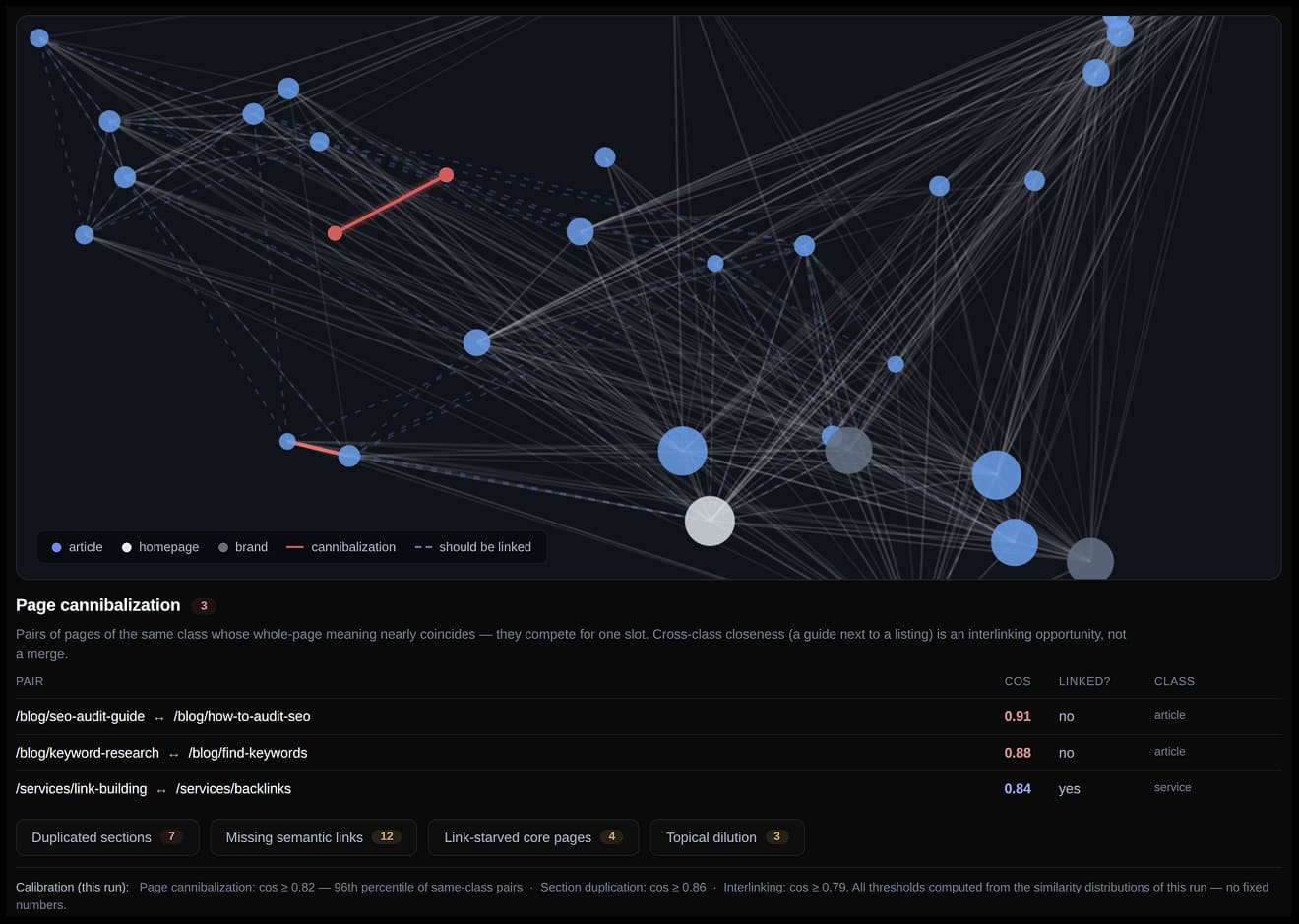
- Articles fighting for one query, and what to do with each. Cannibalizing pairs down to the duplicated section; merges paired, differentiations named. Plus the clusters your site owns and the topics held up by one page.
- Your whole blog triaged: keep, rewrite, merge, delete. Every article graded on depth, E-E-A-T signals, AI-written share and freshness. The junk dragging the domain becomes a named list with a decision per row.
- Blog posts ranking where a solution page should. Commercial queries caught by informational articles, so the visitor arrives in the wrong context to buy. Each one mapped to the page that should own it.
The audit decides which pages are worth rewriting. The rewriting itself is a separate engagement.
Commercial Audit for Solution Pages
Solution pages are audited as pages that sell to a buying committee. What the top gives a buyer, whether your page has it, whether your claims have proof, and whether the entities every competitor names appear on your page at all.
What you see
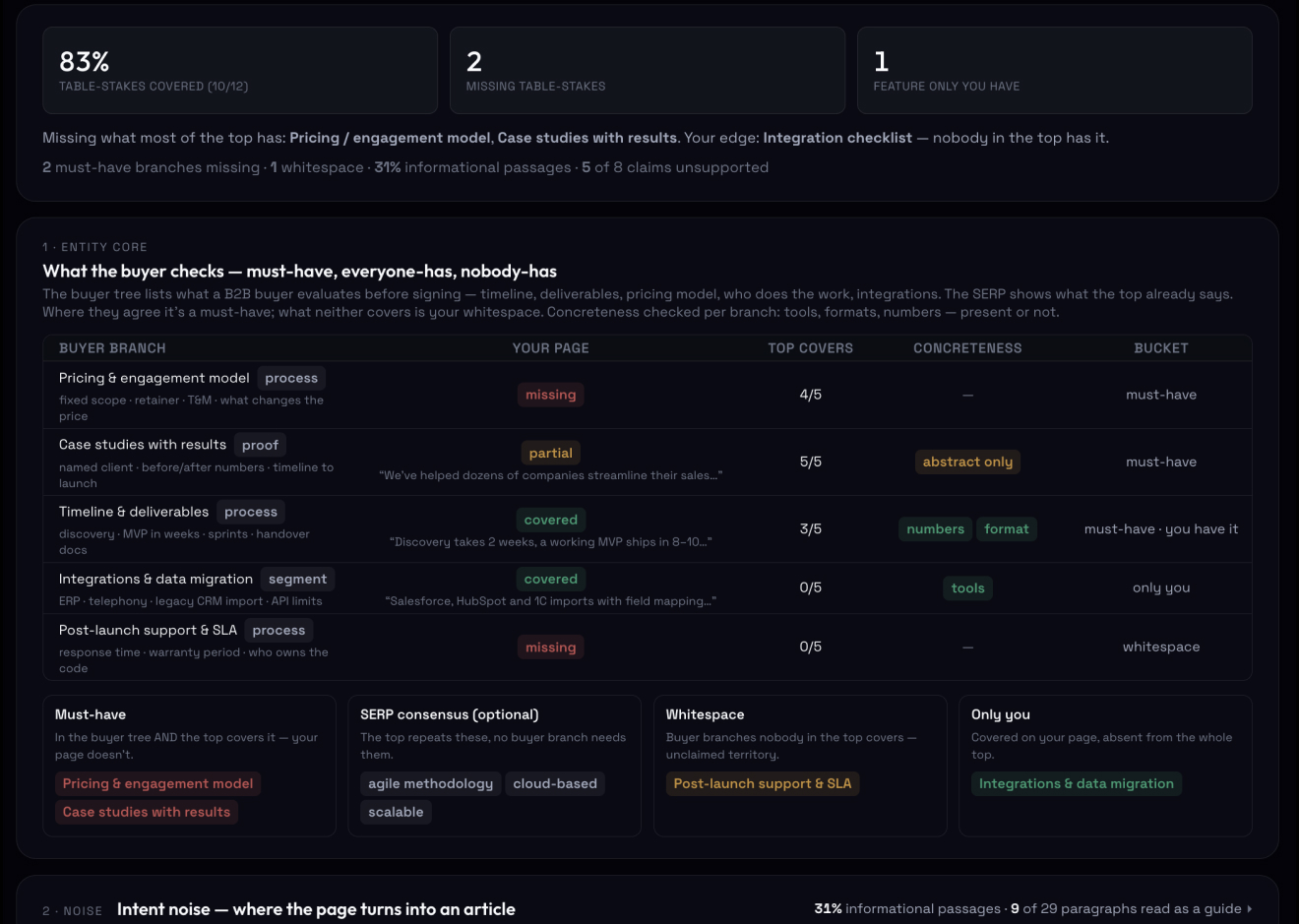
- What every top competitor gives a buyer that your page doesn't. Pricing model, integrations, security, implementation time, named customers. Each checked against the top and ranked by how many competitors cover it.
- Every “cuts costs by 40%” matched to its proof. Claims paired with the case, number or source that backs them, or flagged as unsupported. Plus the anonymous team blocks a buyer and an engine both skip.
- The entities the top names and you don't. Integrations, standards, certifications, platforms, compared competitors: the terms every ranking page mentions and yours doesn't. To an engine, a page without them is about something else.
In vendor due diligence an unverifiable claim counts against you. A missing SOC 2 mention counts twice.
Full Coverage
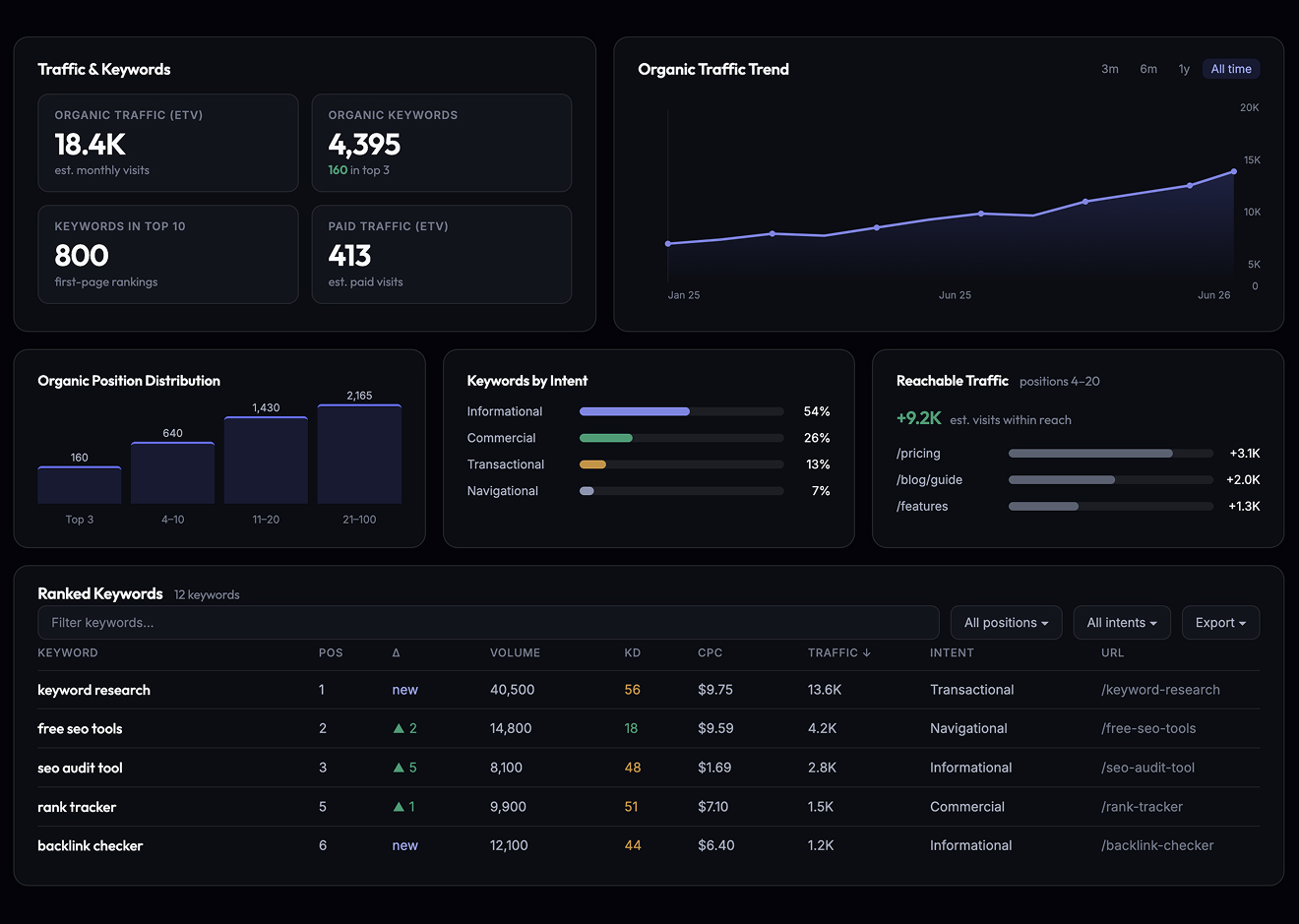
One view of the domain before the funnel diagnosis. Where your organic traffic comes from by intent, which competitors own the queries you need, how much authority backs your revenue pages.
What you see
- Which funnel stages search feeds, and which it starves. Rankings split by informational, commercial and transactional intent, with the queries at positions 4–20 that are closest to paying off.
- The rivals that matter, and their trajectory. Competitors by keyword overlap, the keyword gap against the closest one, traffic share, and momentum: who is growing, who is flat, who is losing.
- Search Console read the way a diagnosis needs. Striking-distance queries, pages cannibalising each other, content decaying month over month, all from your own Search Console data rather than a third-party estimate.
Platform access stays open after the engagement, so every number here can be rechecked later.
AI Visibility Diagnostics
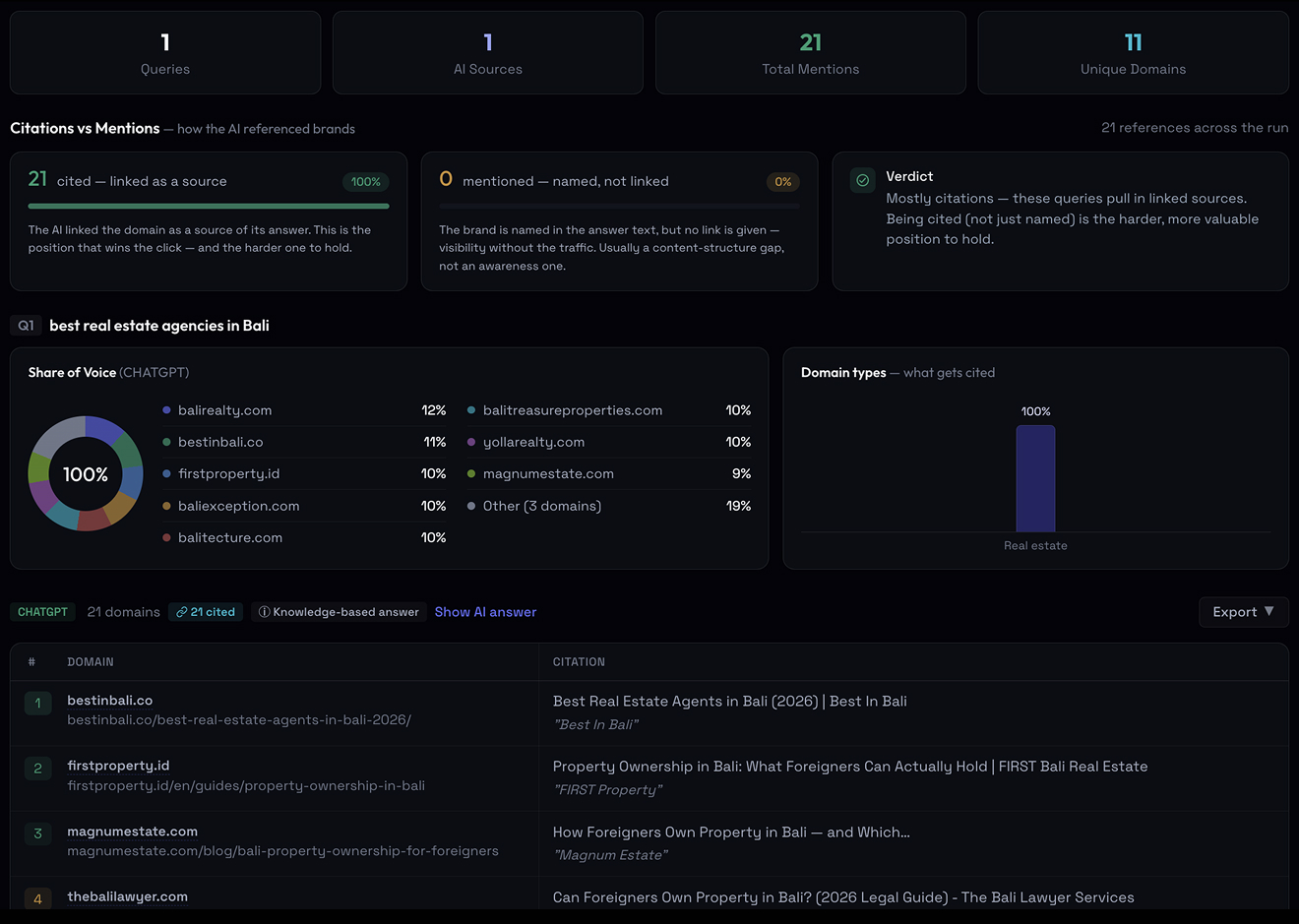
Your buyers ask ChatGPT and Perplexity who belongs on the shortlist. This module tracks whether you're in the answer, and which competitor took your place.
What you see
- Whether you're on the AI shortlist, and who took your slot. Six engines asked “best X for”, “X alternatives” and “X vs Y”. Your presence, your position, and the competitor named when you're absent.
- How you're mentioned, per engine. Each mention classified as recommended, listed, or the option to avoid. A negative mention is a page to fix.
- Presence that repeats across runs. Three to five passes per query, so you act on the brands an engine names consistently and can see where your own presence is random.
Citation tracking stays live in the platform after the audit, so you see the shortlist move over time.