SEO Audit that goes past the checklist

Automated tools hand you a list of broken links and missing tags. Those rarely explain why traffic actually fell. We find the algorithmic issues underneath, the ones no crawler flags.

  • Vector & Entity Analysis
  • Link Devaluation Detection
  • Information Gain Analysis
  • Rendering Efficiency
  • AI Visibility Tracking
  • Powered by Algorithm

The diagnostics a checklist doesn't run

Core Capabilities

Traffic drops rarely stem from missing tags. We analyze core architecture, rendering pipelines, and semantic alignment to pinpoint exact algorithmic triggers.

Update Loss Forensics
Exact triggers behind Core & HCU drops
Information Gain
Content uniqueness & semantic distance
Entity Alignment
Knowledge Graph & Schema architecture
Technical Engineering
Green CWV, but the bot never reaches your deep pages
Link Equity Audit
Silently discounted or toxic backlinks
SXO & Intent Satisfaction
Post-click behavior, pogo-sticking & conversion paths
AI Visibility
Brand citations in AI Overviews & ChatGPT
Algorithmic Risks

Why sites tank after an update Search Console won't explain

None of these show up in an automated crawl. That's why we built our own diagnostics.

01
Silent Link Discounting
Symptom
Traffic drops with zero manual penalties in Search Console.
+
01
Business Impact
Ongoing link budgets generate zero incremental equity.
What We Check
Which parts of your link profile are being silently discounted by the algorithm.
02
Information Gain Deficit
Symptom
Expert content steadily loses visibility after Core Updates.
+
02
Business Impact
High creation costs yield zero organic traffic growth.
What We Check
Semantic distance of your content vs. top-10: what it adds beyond existing sources.
03
Entity & Context Drift
Symptom
Steady ranking decline across entire categories over multiple update cycles.
+
03
Business Impact
Competitors with cleaner architecture steal top-3 conversion traffic.
What We Check
Schema integrity, internal linking, and your brand's footprint in the Knowledge Graph.
04
Rendering & Hydration Bottlenecks
Symptom
Green Core Web Vitals, but Googlebot fails to index deep pages.
+
04
Business Impact
New product or landing pages take weeks to appear in search.
What We Check
How much of your JS the bot actually executes before the crawl budget runs out.
05
Internal Intent Cannibalization
Symptom
New pages push legacy, high-converting pages down instead of growing traffic.
+
05
Business Impact
New content cannibalizes existing rankings and the inbound revenue attached to them.
What We Check
Intent collisions inside your topical clusters that force demotion of whole sections.
06
AI Overview & LLM Citation Loss
Symptom
Rankings look stable, but high-intent traffic drops as engines stop citing your brand in AI answers.
+
06
Business Impact
Competitors get named in AI answers while your brand vanishes from the decision.
What We Check
How often your brand is cited across AI Overviews, ChatGPT and Perplexity, and why.
07
Sitewide Quality Dilution
Symptom
Flagship pages keep improving, yet the whole domain sinks. The site seems capped regardless of page quality.
+
07
Business Impact
Every new page inherits the domain-level suppression, so content spend compounds the problem.
What We Check
The ratio of thin and duplicate URLs, and which sections trip the sitewide classifier.
Proprietary Diagnostics

See What Google Actually Sees

We run your audit on our own engine, backed by the industry-standard tools, and you get the findings as PDF, Excel and Word like anywhere else. The difference: nothing is a black box. You get full platform access, every metric is transparent, and any number in the report is one you can check yourself.

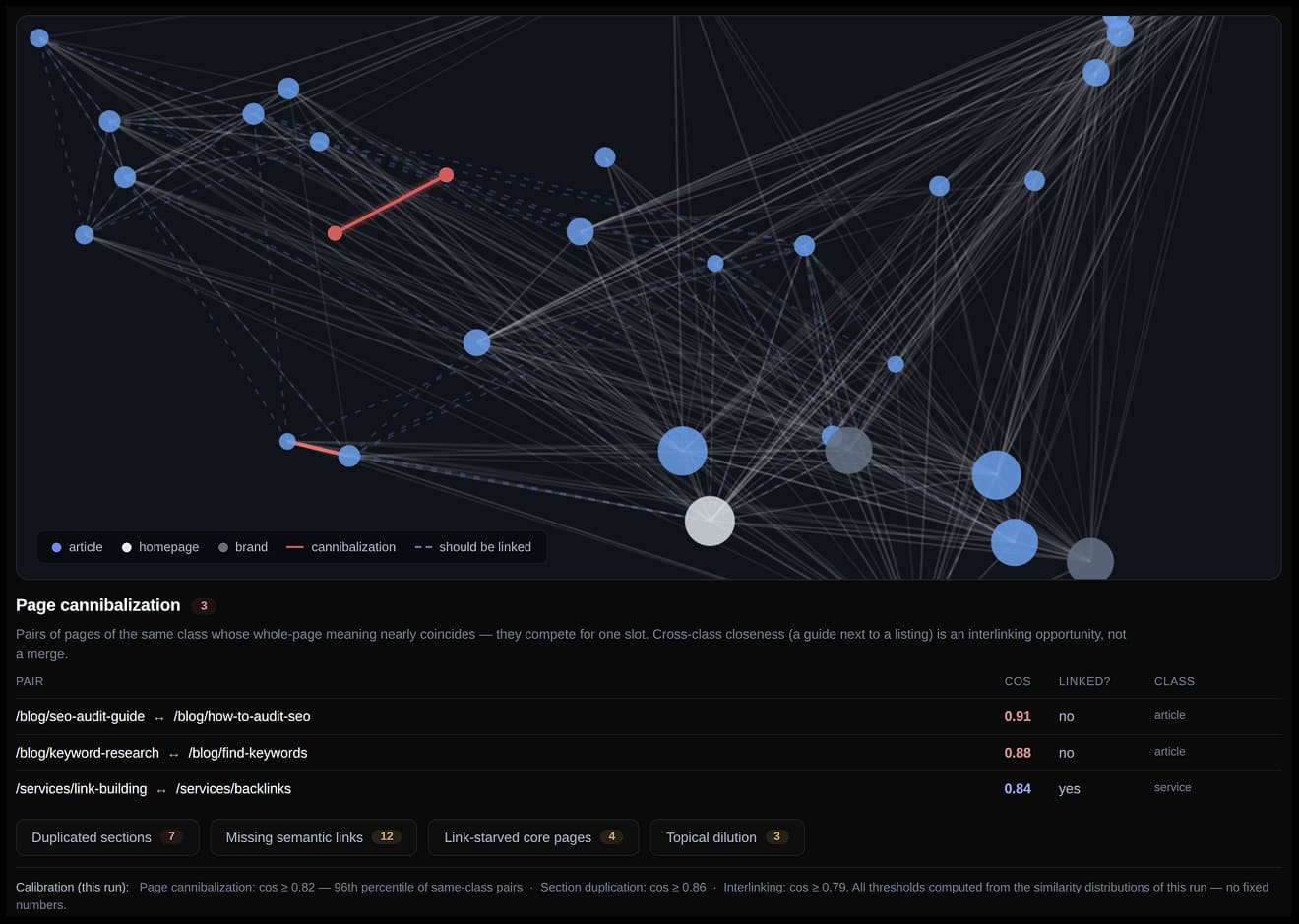
Semantic site map — pages competing for one query and internal-link gaps, Algorithm dashboard
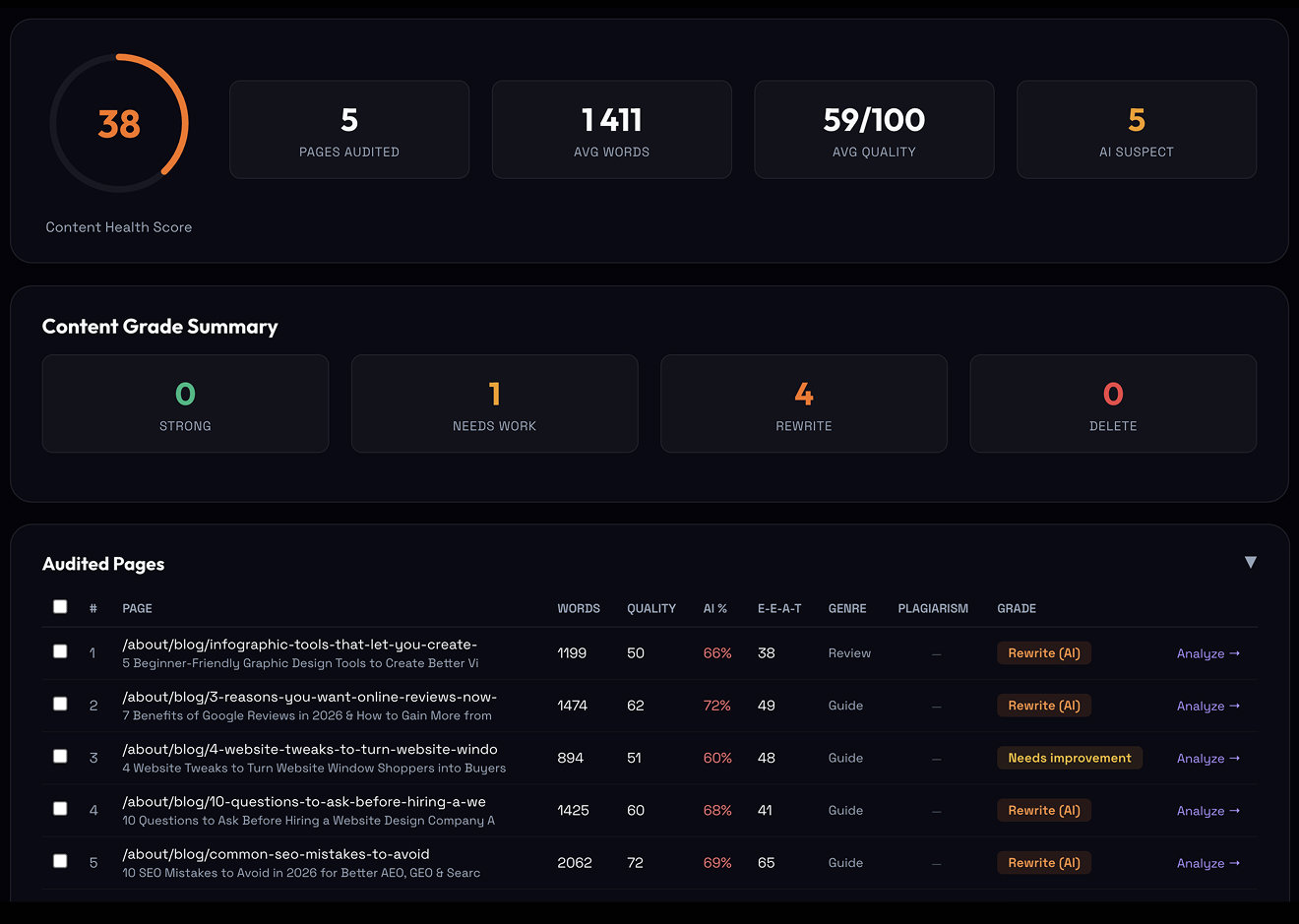
Content authenticity & E-E-A-T audit — AI likelihood, content quality and trust signals
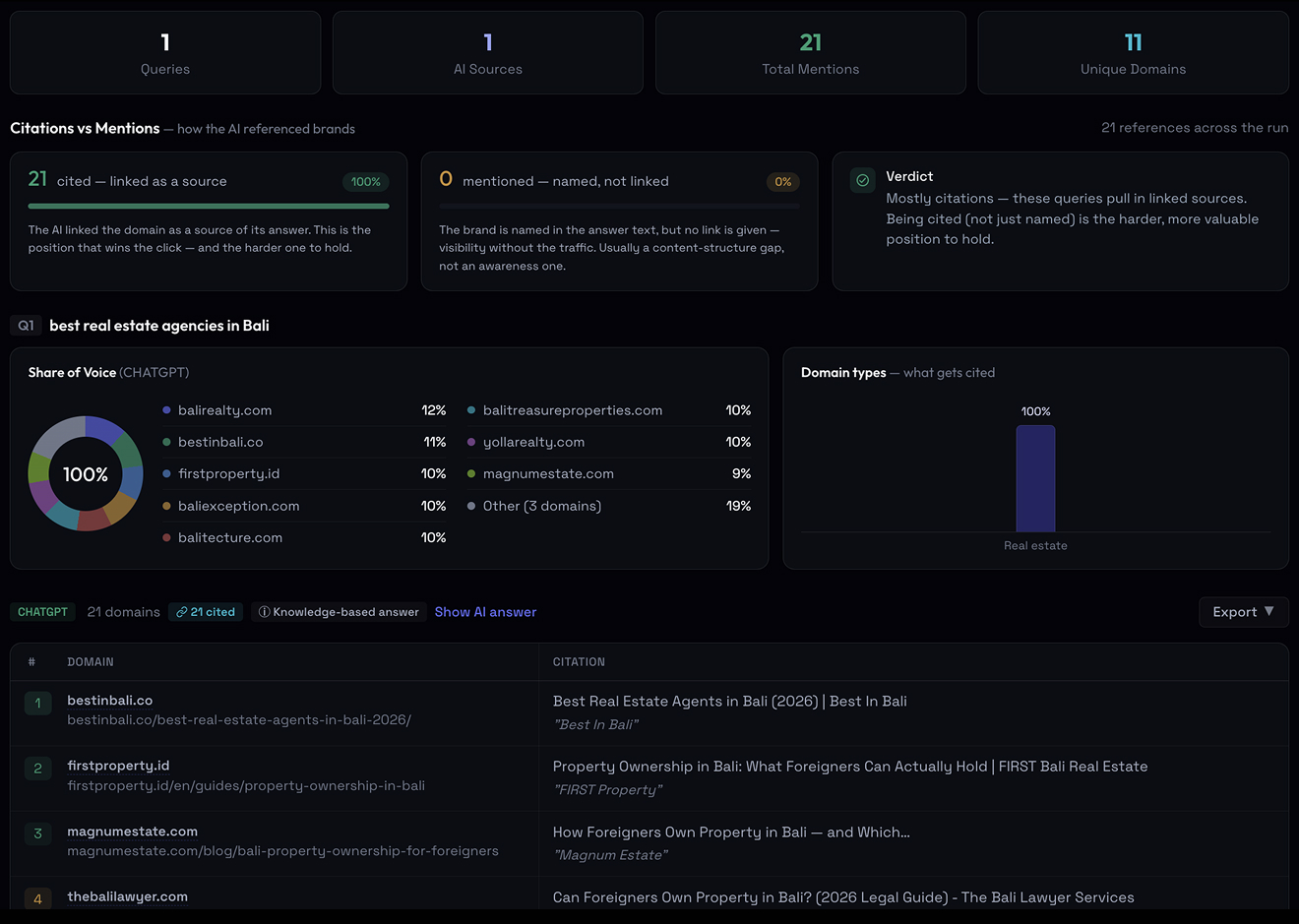
AI visibility diagnostics — share of voice and citation tracking across AI engines

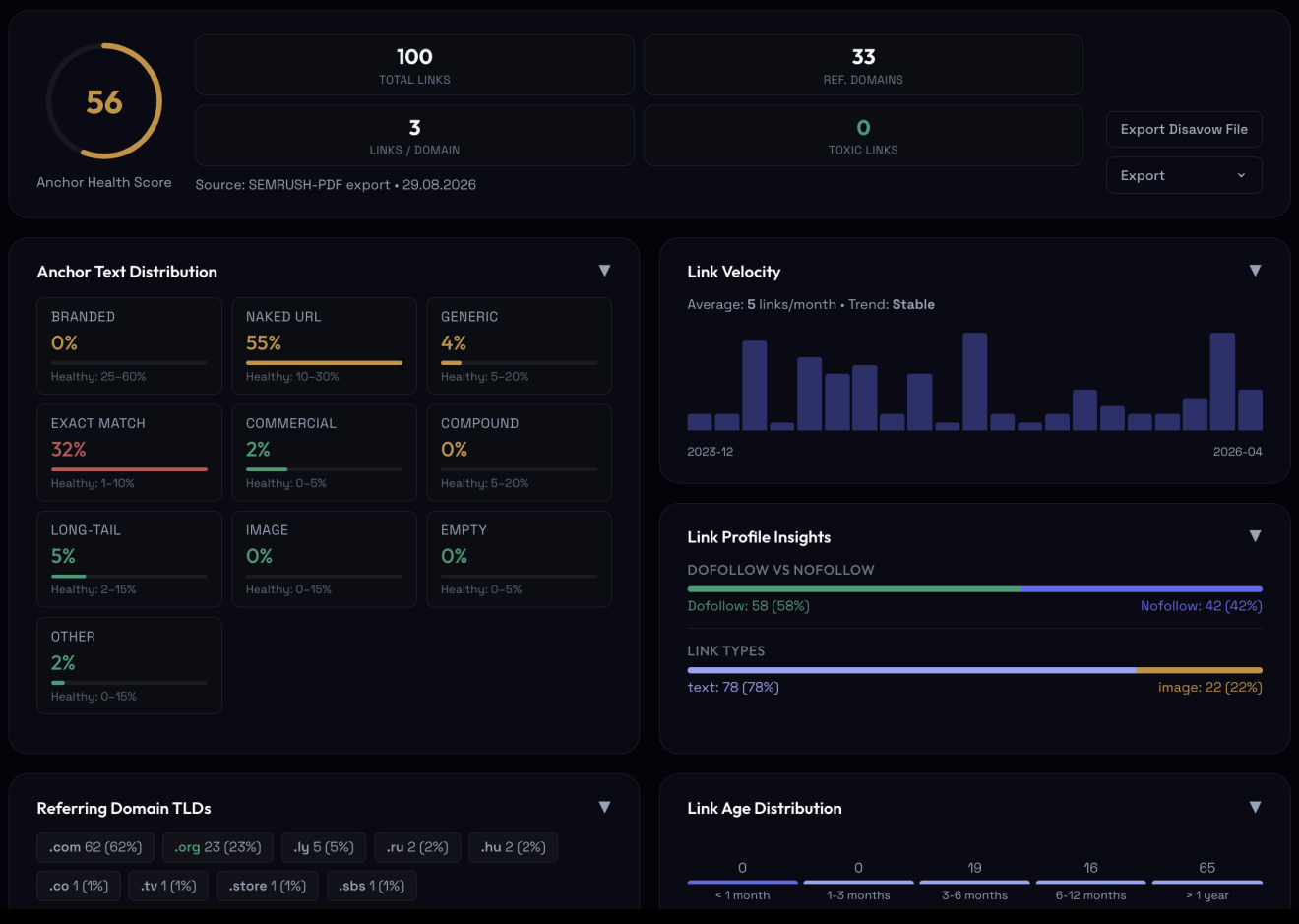
Link Equity & Toxicity

DR inflates easily. What moves rankings is the authority a link actually carries — and that's what the audit isolates, with the evidence behind every flag.

What you see
  • Which links work, and which just look good. Every referring domain ranked: carries authority, or carries the signals Google discounts — paid-post hubs, PBN infrastructure, off-niche filler. Evidence per flag.
  • Where your anchor profile stopped looking natural. Anchor distribution against the over-optimization line, money-keyword spikes by date, and a disavow file reasoned per domain.
  • Your link network, mapped. Domains sharing hosting, ad or analytics IDs, or ownership — one operator voting for you many times — named, with the shared fingerprint.
A score you can resell isn't a score Google reads.

Semantic Site Map & Page Intent

Standard audits compare URLs and titles. We map every page as a vector of meaning: what competes with what, what should link to what, and whether each page is the type Google ranks for its query.

What you see
  • Pages competing for one query, down to the duplicated section. Two articles, or an article and a service page, Google can't choose between — paired, with the call: merge, differentiate or link.
  • Core pages starved of internal links, with their donors. The pages at the centre of your topics sitting at the bottom of internal authority — each with the strong pages that should link to them, and the anchor.
  • Wrong page type for the query. If the top is guides and yours is a landing page, no on-page work fixes it. Format and intent mismatches listed with the page type that wins.
Most “content problems” are structure problems: the wrong page, or two pages, on one query.

Content Authenticity & E-E-A-T

AI search engines attribute facts, not slogans. The audit measures the citability, first-hand experience and proof signals that word count misses.

What you see
  • Your citability against the pages that outrank you. Independent ideas, self-contained passages, named sources, attributed quotes — counted on your page and on theirs. These are what AI answers lift.
  • Every claim on your service pages matched to its proof, or flagged. “Experts”, “15 years”, “trusted by” — paired with the passage that backs it, or listed as unsupported. Plus the anonymous team blocks.
  • AI-written share and staleness, page by page. Which pages read machine-written, which haven't been touched in years, which lack a dated author — ranked by fix order.
AI answers quote sources. A page that is neither a source nor cites one doesn't get quoted.

Full Coverage

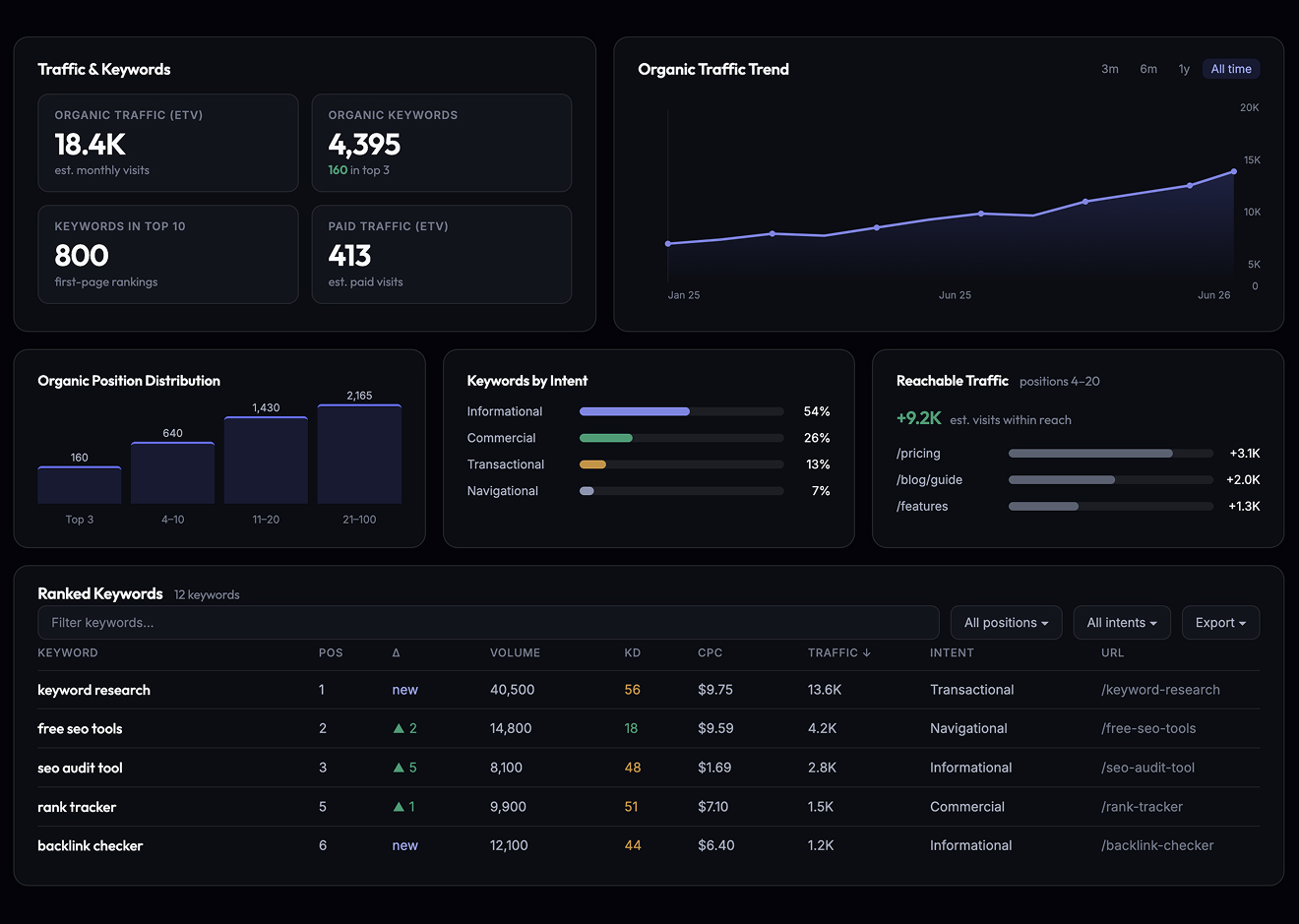
Before any diagnosis, the whole domain on one screen: organic traffic and positions, competitors, backlinks and history — pulled fresh when you ask, with the raw data under every number.

What you see
  • Where your rankings actually sit, and where they're moving. Keywords split by position band — top 3, 4–10, 11–20, beyond — with monthly history and the new / up / down / lost movement; intent and SERP features per query.
  • Who's really taking your traffic. Competitors ranked by keyword overlap with generic giants filtered out, the keyword gap against your closest rival, traffic share and which of them is growing.
  • The signals other tools skip. Traffic concentration, reachable traffic at positions 4–20, Link Risk from your live backlink profile, share of queries with AI Overviews — and the domain's past life from the Wayback Archive.
Other tools sell you the export. Here, the export is where the audit starts.

AI Visibility Diagnostics

AI engines quote what they can attribute. The audit tracks where you're cited across six engines, and whether your pages give them a reason to.

What you see
  • Where you're cited across six AI engines — and who is when you're not. ChatGPT, Perplexity, Gemini, Claude, Grok and Google AI Mode, per query, with the competitor holding your slot named.
  • Recommendations separated from luck. Each query run three to five times: 5/5 is a recommendation, 1/5 is noise. You act on the stable ones.
  • The pages AI actually cites, checked against yours. The sources engines pull from on your queries, run through the same citability check as your page.
Organic rank gets you seen. Citability gets you recommended.
More in the platform Targeted engineering tools built for high-stakes technical scenarios.
Internal Link Analyzer
Orphan pages, click depth, broken links, redirects, noindex and canonical mismatches across up to 5,000 URLs — with content links and navigation links counted separately, the way Google weights them.
Pre-Migration Complex Web Apps
JS-Rendered Crawl & Technical Check
Headless-Chrome crawl for React, Next.js and Vue sites — links and content as Googlebot renders them — plus per-URL indexability, Core Web Vitals, structured data, hreflang and AI-crawler access.
Complex Web Apps
Redirect Chain & Loop Inspector
Bulk detection of multi-hop redirect chains, loops and canonical conflicts across the URL map, up to 500 URLs per run.
Pre-Migration M&A Due Diligence
Indexation Coverage Check
Indexed or not, URL by URL across the sitemap in Google and Bing — the first signal to read after a drop.
Post-Update Drops
Schema Validation & Generator
Structured data validated per URL, and valid JSON-LD generated for 15 types with required and recommended properties checked as you type.
Complex Web Apps Pre-Migration
Content Audit & AI-Footprint Scan
Every article graded on depth, E-E-A-T signals and genre fit; AI-generated share per page; keyword cannibalization and freshness across the whole blog — keep / rewrite / delete as a named list.
M&A Due Diligence Post-Update Drops
Deliverables

What you get, your team can actually ship

Concrete output your team ships from day one: a board-ready PDF brief with written rationale, an Excel-backed engineering backlog, and live platform access to check every finding yourself.

01 Board-Ready Brief

Executive Summary & Risk Map

Concise 2-page briefing for stakeholders on core risks and recovery timelines.

02 Dev-Ready Tickets

Engineering Backlog

Developer-ready technical specs with prioritized tasks (High / Med / Low impact).

03 Real-Time Platform

Algorithm Platform Access

Live client dashboard to monitor indexing, entity status, and ranking dynamics.

04 7-Day Async Support

Implementation Guarantee

Seven days of written engineering support after handoff, with direct Q&A with our Lead Architect as your team ships the backlog.

The Difference

How this differs from the audit you're used to

Regular Automated Audit
Neon Systemic Audit
FocusSuperficial HTML notices & broken links
FocusCore Update drops & architectural flaws
ToolsRaw exports from third-party crawlers
ToolsGSC, Screaming Frog & logs, unified in our Algorithm platform
Output100-page PDF with unprioritized tasks
OutputDeveloper-ready engineering backlog sorted by ROI
DeliveryAccount manager passing PDFs
Delivery7 days of async engineering support with Lead Architect
Workflow

Three weeks from kickoff to a clear picture of what's wrong

Fixed scope. Fixed three-week timeline. Engagements start at $1,500.

Week 1
Data Integration & Baseline
Connecting GSC/GA4 endpoints, extracting server access logs, and initializing full-site Algorithm scanning.
Week 2
Algorithmic Risk Diagnostics
Running vector semantic mapping, JS hydration forensics, entity graph audits, and backlink equity filtering.
Week 3
Delivery & Technical Defense
Handing over developer-ready backlogs, board briefing, and opening a 7-day async support window for your engineering team.
Audits We Run

One method, tuned to how your site actually sells

B2B SEO Audit Ecommerce SEO Audit Enterprise SEO Audit Technical SEO Audit Backlink Audit Content Audit
Frequently Asked Questions

Before You Ask

Most agency audits are repackaged crawler exports. Send it over. If it already covers systemic diagnostics, we'll tell you, and you'll save the budget.

You should, and you'll get the checklist layer. What crawlers can't see is silent link devaluation, information gain deficit, and entity drift. That's the layer we built Algorithm for.

Then you get a documented confirmation that your architecture is sound, which is exactly what you need before a migration, relaunch, or acquisition.

Read-only Google Search Console and analytics. Server logs help but aren't required. No code access needed for the diagnostic phase.

Sometimes the honest answer is that patching costs more than rebuilding. If the audit shows that, we say so, with the numbers to back it. And because design, development and SEO all sit in-house, we can take the rebuild from architecture to launch ourselves. Either way, you leave with a clear-eyed decision.

You talk to the people doing the work, not an account manager

Direct Contact

Lead at Neon. Built Algorithm, our in-house analytics platform. 10+ years in search & digital design. Senior-only delivery.

Roman Makuev
Roman Makuev
Not sure if your site needs a full systemic audit?

Send us your URL. We'll take a quick initial look and tell you honestly if an audit makes sense for your current situation. No pitch, no pressure.