Ecommerce SEO Audit for catalogs Google ranks wrong

Your problem usually isn't a lack of traffic. It's that Google crawls the wrong pages, ranks the wrong pages, or sends the wrong searches to the pages that actually drive revenue.

  • Crawl Budget Analysis
  • Catalog Architecture
  • Faceted Navigation Audit
  • Product Lifecycle Equity
  • Revenue-Page Priority
  • Powered by Algorithm

Ecommerce SEO audit diagnostics built for catalog scale

Core Capabilities

Missing meta descriptions almost never explain a stalled store. We analyze crawl paths, catalog architecture, and commercial intent to find where your revenue pages are losing search visibility.

Crawl Budget & Indexation
Crawl paths, parameter URLs & index bloat
Faceted Navigation Audit
Which facets deserve to exist in search
Category Architecture
Taxonomy depth, category content & internal logic
PDP Quality & Uniqueness
Duplicate manufacturer copy, attributes & PDP schema
Catalog Cannibalization
One canonical destination per commercial intent
Product Lifecycle Equity
301/410 logic that preserves accumulated equity
Link Equity & Authority
Authority flow from homepage to money pages
SERP & AI Visibility
Clicks lost to SERP features & AI answers
Symptom → Diagnosis

You see the symptom, we trace it to the SKU

01
Traffic Without Revenue
Symptom
“Traffic is growing, but sales aren't.”
+
01
The Real Problem
You're attracting searchers, not shoppers. Informational traffic that never converts.
What We Check
Organic → revenue by query, category and product; branded vs non-branded; landing-page intent.
02
Indexed But Not Ranking
Symptom
“Our products are indexed, but don't rank.”
+
02
The Real Problem
Thin, near-duplicate PDPs. Google sees your products as interchangeable documents.
What We Check
Duplicate & manufacturer copy, attribute coverage, reviews, variants, PDP schema.
03
Categories Don't Rank
Symptom
“Our category pages don't rank.”
+
03
The Real Problem
Bare product grids with no context. Google can't tell what the category is or who it's for.
What We Check
Category → keyword mapping, unique content, subcategory architecture, entity coverage, schema.
04
Crawl Waste
Symptom
“Google crawls URLs nobody searches for.”
+
04
The Real Problem
Crawl budget spent on parameter and duplicate URLs while revenue pages get ignored.
What We Check
Crawlable vs indexed URLs, parameter & faceted URLs, orphan products, crawl depth, wasted paths.
05
Facet Explosion
Symptom
“Filters create more pages than our catalog.”
+
05
The Real Problem
Faceted navigation multiplies thousands of SKUs into hundreds of thousands of URLs.
What We Check
Which facets deserve to exist in search vs. which consume crawl and index capacity.
06
Buried Best-Sellers
Symptom
“Our best-sellers are buried four clicks deep.”
+
06
The Real Problem
Internal authority doesn't flow toward the products that actually drive revenue.
What We Check
Internal link architecture, click depth, authority flow, product discovery paths.
07
Lost Product Equity
Symptom
“Out-of-stock products destroy our SEO equity.”
+
07
The Real Problem
Ranking products go 404 or redirect to home, and accumulated links and rankings vanish.
What We Check
In-stock → out → discontinued lifecycle: 301/410, keep-page, alternatives, preserved reviews & links.
08
Catalog Cannibalization
Symptom
“Multiple pages compete for the same search.”
+
08
The Real Problem
Several category/URL variants fight for one commercial query, and none win cleanly.
What We Check
Canonical commercial destination per intent, URL variants, category overlap, internal competition.
Proprietary Diagnostics & Continuous Access

See your whole catalog the way Google actually crawls it

Where standard tools sample a few pages, we map your catalog on our own engine — every category, filter and product URL as it crawls, indexes and competes with the rest — and grant your team full platform access during and after the audit.
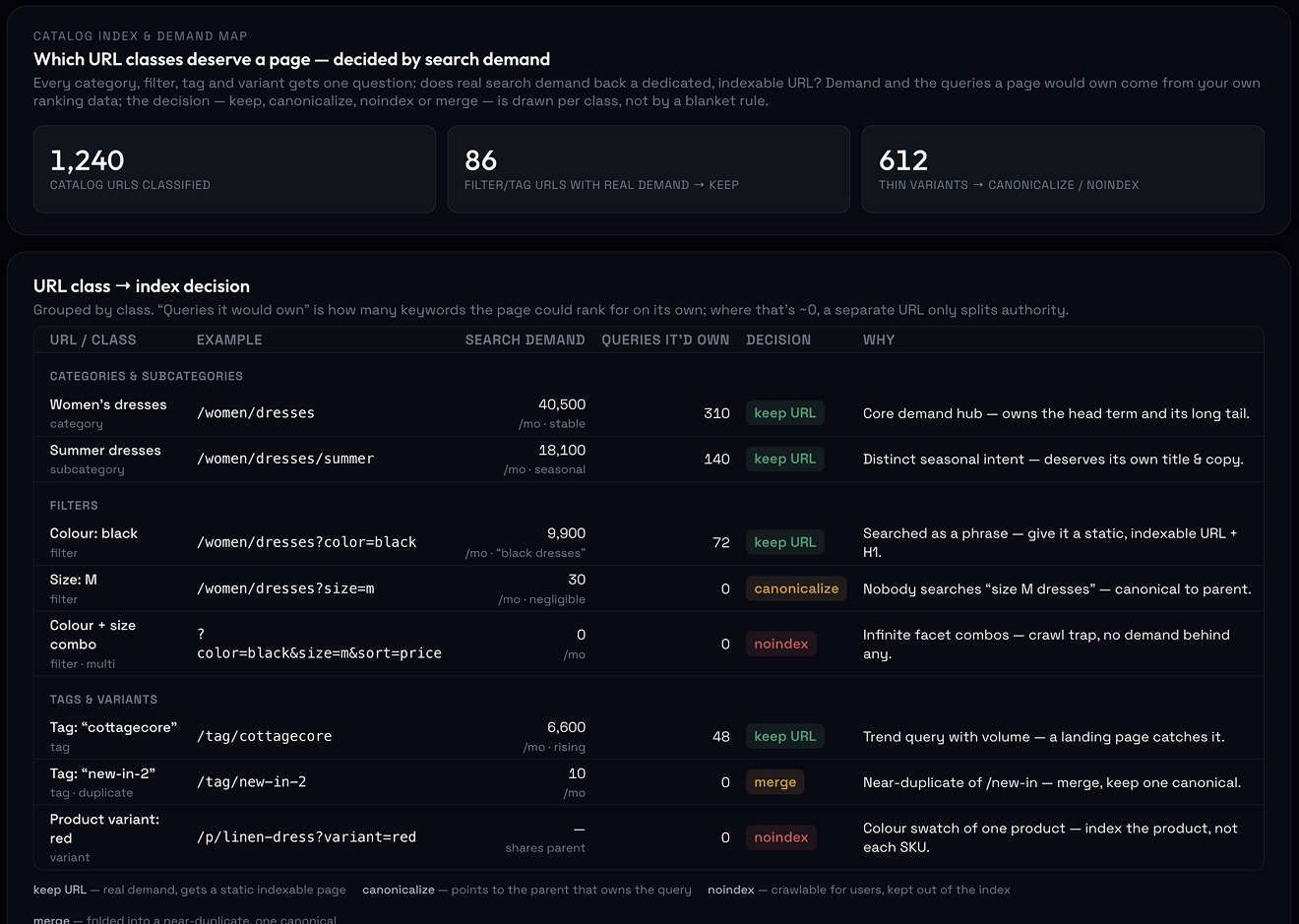
Catalog index and demand map — which filters deserve a URL, which URL owns each query
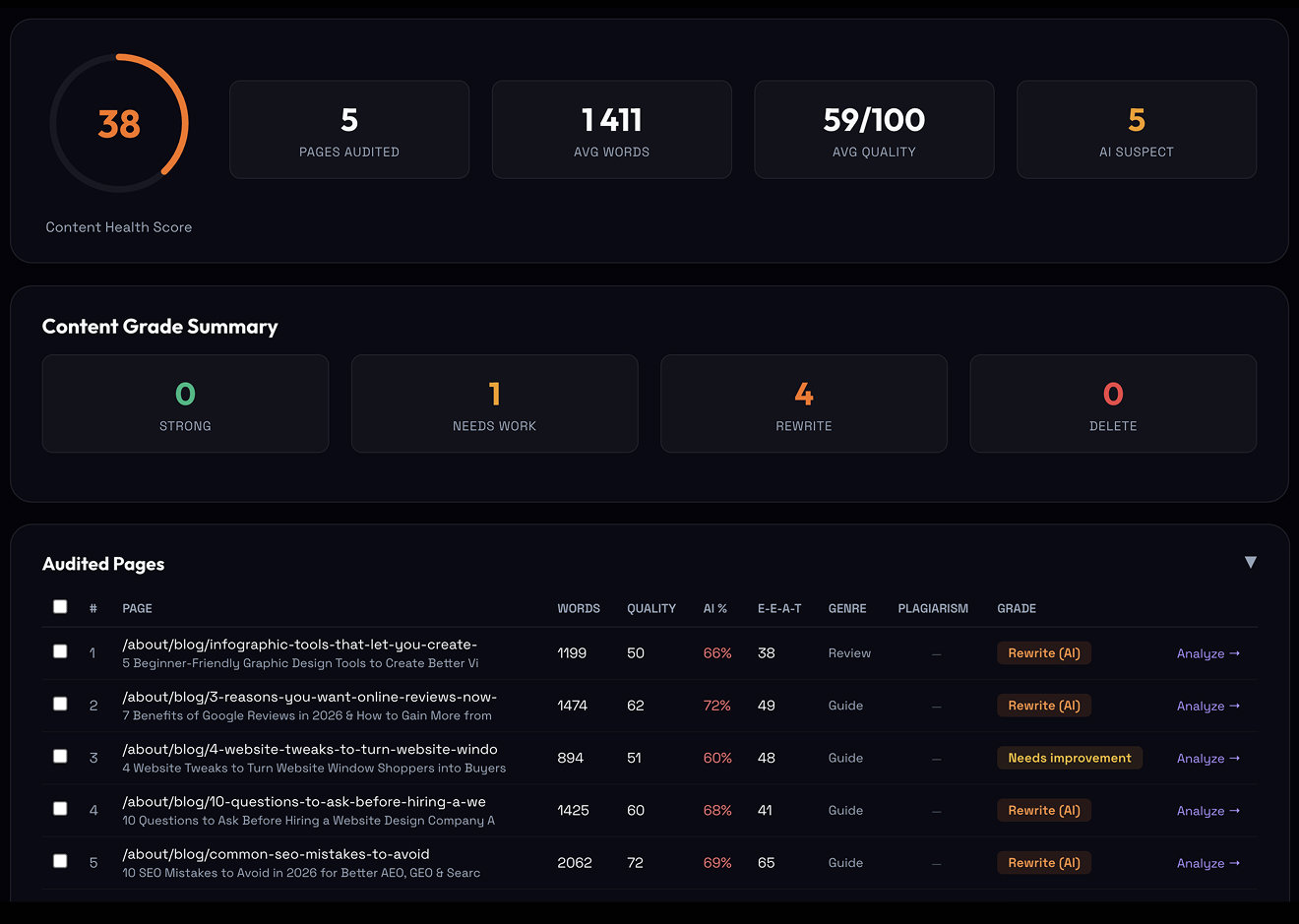
Content authenticity & E-E-A-T audit — AI likelihood, content quality and trust signals
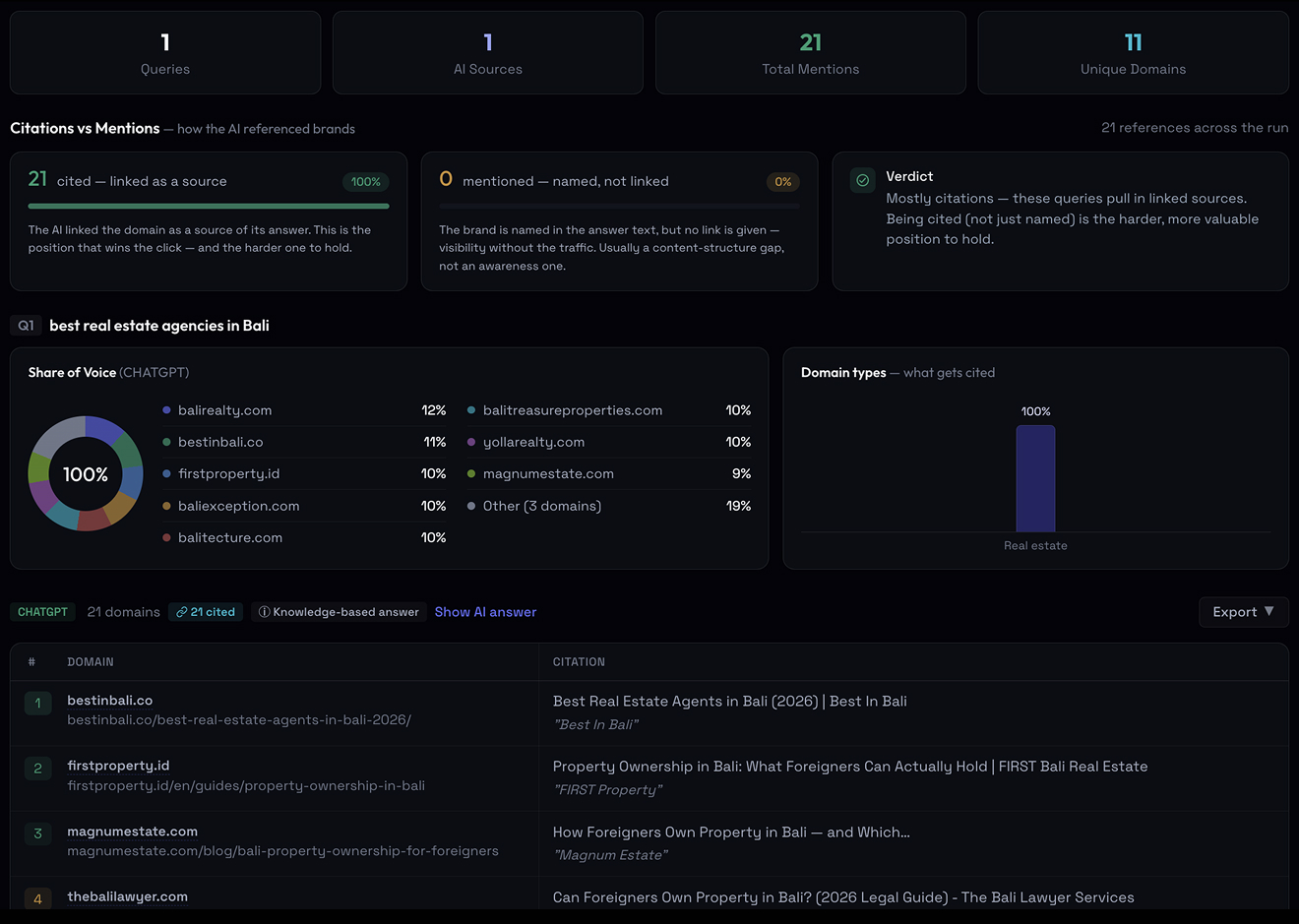
AI visibility diagnostics — share of voice and citation tracking across AI engines

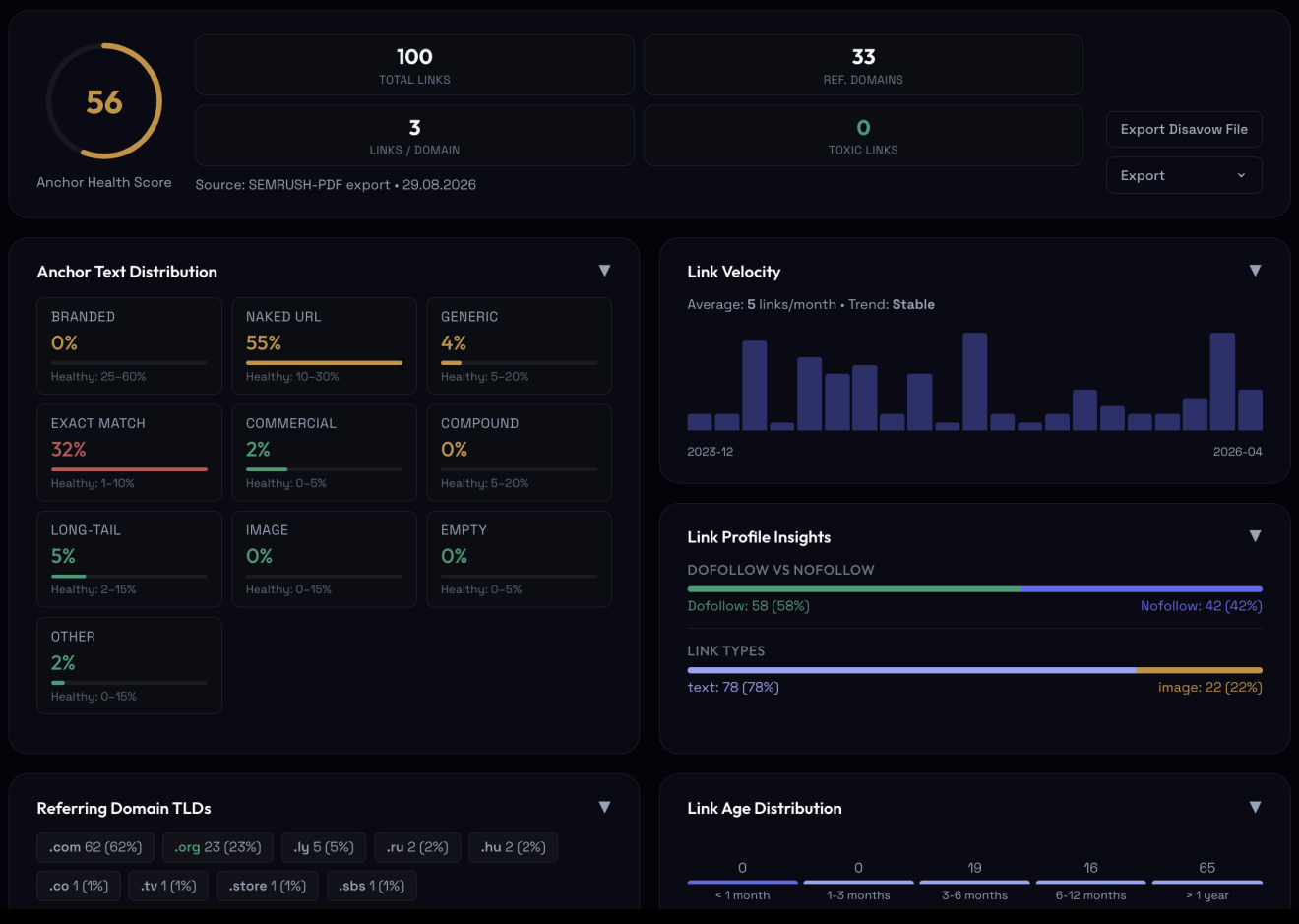
Link Equity & Toxicity

Store link profiles pool at the homepage. The audit maps whether any authority reaches the categories that sell — and which donors carry the signals Google discounts.

What you see
  • Which categories get authority, and which sell without any. External links per URL — usually the homepage has them all — plus the internal donors that should feed each category, named.
  • Money-keyword anchors before they look bought. “Buy”, “cheap”, product-name anchors as a share of the profile, with spike dates. Store profiles cross the line fast.
  • Donors carrying the signals Google discounts. Coupon farms, paid-review hubs, network sites sharing hosting or ad IDs — flagged with what gave them away.
Homepage authority that stops before your category pages earns you nothing.

Catalog Index & Demand Map

Every URL class — categories, filters, tags, variants — gets one question: does it deserve its own place in the index? The dividing line is search demand, and we draw it per category.

What you see
  • Which filters and tags deserve their own URL — and which don't. Filter and tag combinations with real search demand get a static URL, title and description; the rest are canonicalized or closed. A named list per category.
  • Which URL should own each query. Categories, filters and blog posts competing for one intent, sections duplicated between listings, variants multiplying near-duplicates — decided by meaning, not by title.
  • Crawl budget spent where it pays. Infinite filter and sort combinations — the URLs that trap crawlers with no demand behind them — closed off, so Google spends its crawl on the categories that actually rank.
A high-value intent with no page built to catch it is money on the floor.

Content Authenticity & E-E-A-T

Product claims, specs and reviews are measured as citable facts — the source signals shopping SERPs and AI answers actually attribute.

What you see
  • Manufacturer copy and templated descriptions, by range. Product pages running feed text found elsewhere on the web, and AI-templated descriptions — ranked by how many products share the problem.
  • Specs with sources, adjectives without. “Premium quality” convinces no engine and no shopper. The pages where a number would replace an adjective, listed.
  • Product and review markup that matches the page. Structured data validated per URL; the mismatches that cost rich results, named.
A spec with a source beats an adjective every time.

Full Coverage

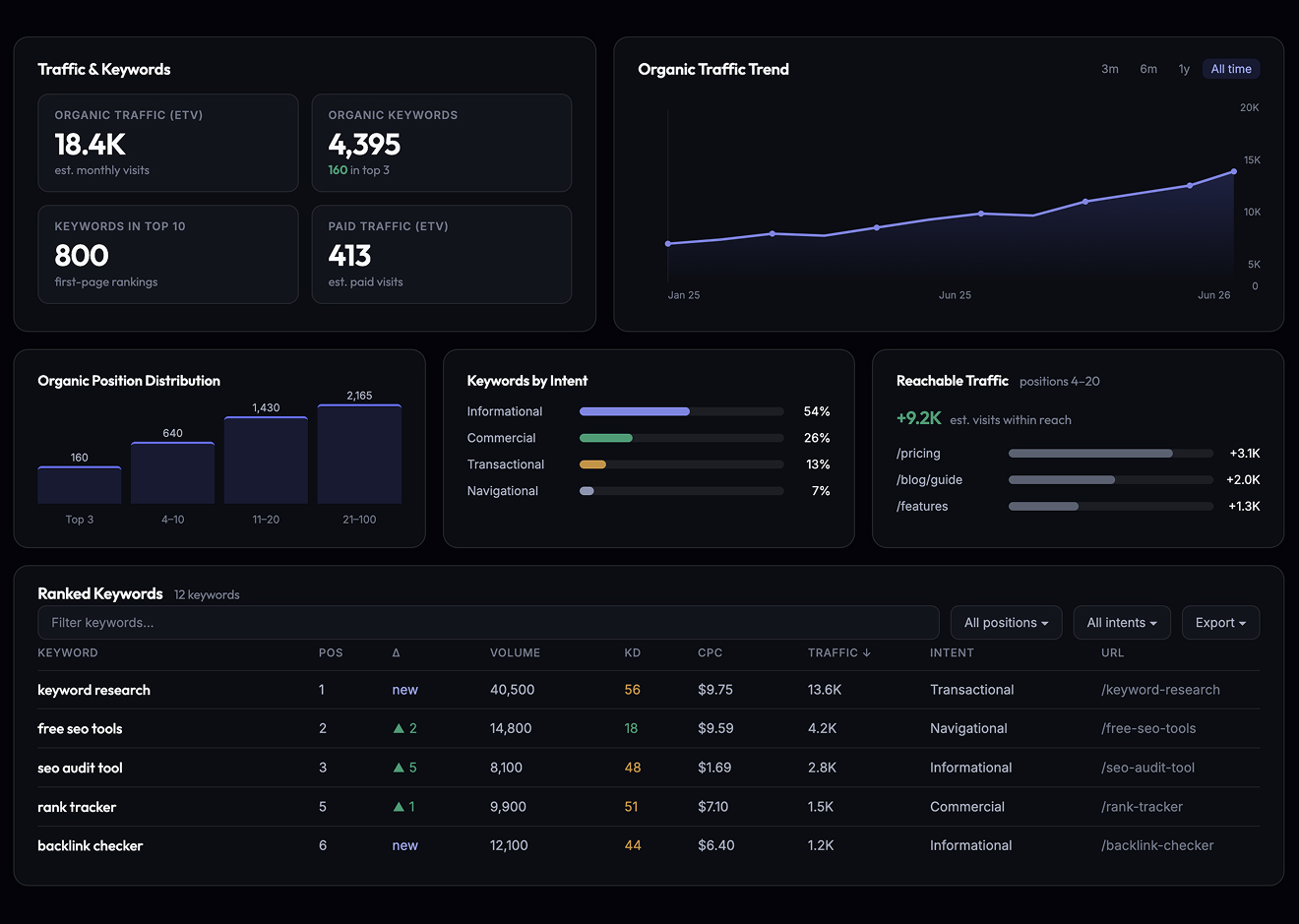
The store as one dataset: organic demand by country and intent, the categories that earn traffic, the competitors holding the queries that sell — and the authority behind each.

What you see
  • Where the store's traffic really lands. Top pages by organic traffic and keywords, so you see which categories carry the store and which sell without any search demand behind them.
  • Demand by market and by intent. Traffic and keywords across countries, transactional vs informational split, and the queries at positions 4–20 with the traffic they'd earn in the top three.
  • The competitors holding your money queries. Keyword gap against your closest rival, traffic share, momentum — and Link Risk on a profile where money-keyword anchors pile up fast.
A catalog needs data at catalog scale. A ten-page sample walks past the problem.

AI Visibility Diagnostics

Shoppers ask AI what to buy. This module tracks which products and categories get you cited, and where competitors own the recommendation.

What you see
  • Whether your products are in the “best X” answers. Six AI engines queried on the questions buyers ask — “best”, “worth buying”, “vs” — your products marked present or absent per engine.
  • Who AI recommends where you're absent, by category. Named competitors per query, share of recommendations per engine, and how they're mentioned: recommended, listed, criticised.
  • The category pages AI would cite — and the ones it won't. Freshness, dated content and source signals on your category pages against the pages engines currently pull from.
The AI answer is the new shelf placement.
More in the platform Targeted engineering tools built for high-stakes technical scenarios.
Internal Link Analyzer
Orphan pages, click depth, broken links, redirects, noindex and canonical mismatches across up to 5,000 URLs — with content links and navigation links counted separately, the way Google weights them.
Pre-Migration Large Catalogs
JS-Rendered Crawl & Technical Check
Headless-Chrome crawl for React, Next.js and Vue sites — links and content as Googlebot renders them — plus per-URL indexability, Core Web Vitals, structured data, hreflang and AI-crawler access.
Headless Storefronts
Redirect Chain & Loop Inspector
Bulk detection of multi-hop redirect chains, loops and canonical conflicts across the URL map, up to 500 URLs per run.
Replatforming Catalog Pruning
Indexation Coverage Check
Indexed or not, URL by URL across the sitemap in Google and Bing — the first signal to read after a drop.
Post-Update Drops
Schema Validation & Generator
Structured data validated per URL, and valid JSON-LD generated for 15 types with required and recommended properties checked as you type.
Product Schema Replatforming
Content Audit & AI-Footprint Scan
Every article graded on depth, E-E-A-T signals and genre fit; AI-generated share per page; keyword cannibalization and freshness across the whole blog — keep / rewrite / delete as a named list.
Large Catalogs Post-Update Drops
What You Won't Get

A revenue-page fix list, not a URL dump

A Typical Store Audit
A Neon Ecommerce Audit
What you getAn 80-page report: fix your meta descriptions and image alt text
What you getWhich problems are actually suppressing your revenue pages
The scopeA find-and-replace exercise across product templates
The scopeCrawl, indexation, catalog architecture, intent and product lifecycle
The formatA 200-row spreadsheet nobody can prioritize
The formatRevenue-page priority, P0 indexation to P3 hygiene
The measureTraffic, rankings, and Domain Authority
The measureCrawl efficiency, commercial visibility, and revenue pages
The question left open"Okay… but why isn't the store growing?"
The question answeredWhere your catalog loses visibility, clicks and revenue, and how to fix it
Deliverables

What you walk away with, priority-ranked and ready

Concrete output your team ships from day one: a PDF priority list with written rationale, an Excel workbook of catalog findings, and live platform access to check every URL yourself.

01 P0 → P3

Revenue-Page Priority List

Every finding scored from P0 (indexation & revenue) down to P3 (hygiene), so you fix what moves money first.

02 Crawl & Index Map

Crawl & Indexation Blueprint

Which URLs to index, block, canonicalize or prune, with a faceted-navigation ruleset for your CMS.

03 Category & PDP

Catalog Architecture Plan

Search-driven taxonomy, category page briefs, and PDP templates built to rank and scale.

04 Lifecycle Rules

Product Lifecycle Playbook

Out-of-stock and discontinued logic (301/410, keep-page, alternatives) to preserve accumulated equity.

05 Real-Time Platform

Algorithm Platform Access

Live view of indexation, rankings and crawl coverage across the catalog on our Algorithm platform, yours during the audit and after handoff, so your team can verify any URL at source.

06 7-Day Async Support

Implementation Guarantee

Seven days of written engineering support after handoff, with direct Q&A with our Lead Architect as your team ships the fixes.

Process

How the audit runs, four steps

Fixed scope. Clear timeline, typically 3–4 weeks. Engagements start at $1,500.

Step 1
Full Catalog Crawl
Connecting data sources and crawling the entire catalog to map every crawlable, indexed and wasted URL.
Step 2
Demand & Architecture Mapping
Mapping real search demand against your taxonomy, categories, facets and product pages.
Step 3
Diagnostic Synthesis
Synthesizing findings into revenue-page priorities scored from P0 indexation to P3 hygiene.
Step 4
Walkthrough & Ticket Hand-off
Live walkthrough with your team and hand-off of dev-ready tickets and CMS rulesets.
Frequently Asked Questions

Before You Ask

Most store audits are a find-and-replace exercise: fix meta descriptions and image alt text. We map search demand against your actual catalog and diagnose where crawl, indexation, intent and product lifecycle are suppressing your revenue pages.

A complete ecommerce diagnostic typically takes 3 to 4 weeks, depending on catalog size, the number of URLs your CMS generates, and platform complexity.

Yes. The audit is platform-agnostic: Shopify, Magento, WooCommerce or custom. Every deliverable ships as developer-ready tickets and CMS rulesets your in-house or agency team can execute directly.

Sometimes the honest answer is that patching costs more than rebuilding. If the audit shows that, we say so, with the numbers to back it. And because design, development and SEO all sit in-house, we can rebuild the catalog architecture from the ground up without losing the rankings and link equity you've already earned. Either way, you leave with a clear-eyed decision.

Read-only access to Google Search Console and your analytics is enough. No admin, CMS or code access needed. Our crawler maps how your facets, parameters and product templates generate URLs directly from the live catalog, and we pull backlink and ranking data through our own Algorithm platform, so you don't need a paid Ahrefs or Semrush seat on your side.

You talk to the people doing the work, not an account manager

Direct Contact

Lead at Neon. Built Algorithm, our in-house analytics platform. 10+ years in search & digital design. Senior-only delivery.

Roman Makuev
Roman Makuev
Not sure if your store needs a full audit?

Send us your URL. We'll take a quick initial look and tell you honestly if an audit makes sense for your current situation. No pitch, no pressure.