Most B2B redesigns make the site prettier and the pipeline worse. Here's the sequence I run instead — and the traps that kill rankings at each stage.
A company decides the site looks old. They bring in a studio, get something cleaner, launch it, feel good about it for a week. Then the demo requests don’t move. Sometimes they drop. A month and a half later somebody finally opens Search Console and notices half the old rankings are just gone, and nobody in the room can tell you why.
I’ve been called in to fix that exact mess more times than I want to count. I’m Roman Makuev. I run SEO and design at Neon Team — fourteen years of this, across the US, Russia and Asia. At some point I got sick of arguing about SEO from memory and built my own analysis tool, Algorithm, so the work was measurable instead of a matter of opinion. What follows comes from autopsies on redesigns that died exactly the way I just described, laid out in the order I actually run — skip a stage and you usually pay for it two stages later.
The deep technical layer — semantic core, architecture, Core Web Vitals, schema — lives in a separate piece, SEO Starts Before the First Line of Code. This guide is about the redesign itself: what’s different when you already have a site, traffic, and rankings you can’t afford to set on fire.
TL;DR
- Two failure modes: the right people never find the site, or they find it and leave. Same root — it wasn’t built around a real buyer.
- Migration is where the traffic bleeds out. “Set up 301s” is maybe a third of the story; rankings die from deleted pages, broken internal links, and rewritten titles that were quietly earning.
- Don’t copy the top ten — cover the intents and segments they missed, one page per question.
- Don’t rewrite the whole blog for “topical authority.” In 2026 that’s how you earn a domain-wide penalty. Ship 5–10 pieces with real cases instead.
- Sometimes the honest call is: don’t redesign yet. If the math doesn’t close, design doesn’t fix it.
Every weak B2B site I’ve audited has one of two problems, and they call for different work — so name yours before you spend a dollar on design.
One: the right people never see it. Your buyers ask narrow questions — in Google, and more and more in ChatGPT, Perplexity and the AI Overviews: “[category] for a 200-person fintech,” “how do we do [the job] without hiring for it.” If no page on your site is the answer to a question like that, the buyer never meets you — and no visual refresh or ad budget changes it.
Two: they see it and leave. Traffic’s fine, demos aren’t. This is the one everybody reaches for a redesign to fix — new hero, shorter form, cleaner homepage — and it’s the one a redesign fixes least reliably, because the problem usually isn’t visual.
Both come from the same place: a site that wasn’t built around an honest picture of the buyer — who they are, what they type into the box, what makes them trust you — fails on both fronts at once.
Here’s the one sentence from this whole guide worth keeping: you can buy attention, you can only build trust. The ad, the ranking, the AI citation — that’s the click, and the click is rented. What happens in the four seconds after is engineered or it’s left to luck.
Why does it keep happening? Look at how a redesign usually gets staffed. A studio takes the visuals. An SEO agency gets “looped in,” whatever that means. A freelancer writes the words. Three competent people, zero shared plan — and the money leaks out of the gaps between them. I inherit both of the wrecks this produces, constantly. The beautiful invisible one: minimal, genuinely nice — and a ghost to Google, URLs shuffled with no redirect map, ranking pages binned for not fitting the new grid. And the opposite wreck: keyword sludge wall to wall, no hierarchy, no air, no clue who it’s for. Might rank for a while. Converts like wet cardboard.
Both happen for the same dumb reason — the two jobs get run as a relay: build it, then optimize it. That handoff is the leak, because every SEO decision worth anything is a build decision, and the reverse. The standing rule for every step below: design and search in one plan, often in the same head.
Most guides say “understand your audience” and move on, which helps no one. Here’s the pass I actually run.
Start with the pain, not the persona. Drop the demographics for a second. What’s the problem this buyer is actually trying to solve, and what’s the voice in their head when they hit the page? A VP of Engineering checking out an infrastructure tool isn’t thinking “I’d love a flexible, enterprise-grade solution.” She’s thinking will this fall over in production and will my CTO have my head for it. Answer the fear, not the feature.
Then read the buyer’s income and status, because it rewrites the whole design — I learned this one the hard way. Premium audiences read minimalism and white space as status and trust; to them, clutter looks like a scam. Mass-market audiences read it backwards: they want social proof, loud benefits, “chosen by 1,000+ companies” — too much empty space reads as cheap or half-finished. There’s no universal “good design.” There’s design that’s right for one buyer.
Generation matters too: millennials lean toward storytelling and a clear “why us”; Gen Z wants sincerity, anti-stock visuals, video — anything staged and they’re gone.
Then the part that separates B2B from B2C: the committee. A consumer decision is one person, one sitting; a B2B decision is a long cycle that finance, IT and leadership will all pick apart before anyone signs. Two consequences. These buyers judge credibility before capability, starting on the first screen. And one homepage can’t carry three roles — the engineer, the RevOps lead and the CFO each arrive with a different problem and a different bar for trust.
None of this is for a slide deck. Every decision downstream — which pages exist, what the hero says, where the proof sits, how many fields the form dares to ask — should trace back to a real person’s problem.
Do the standard teardown: which blocks the top sites have — FAQ, comparison table, pricing, the usual trust elements — and make sure you’ve got them too. A page missing the blocks buyers expect feels unfinished; they notice, and so does Google.
But matching the top ten is a floor. If your new site is just a tidier remix of what already ranks, you’ve built a copy — and copies have a specific problem in 2026, which the blog section comes back to: they don’t get indexed, because they hand the index nothing it didn’t already have. The win is past where the competitors stopped looking.
One principle, and it’s the same whether you’re thinking SEO or design: every page answers one question for one person. Most B2B sites are filed under the company’s own furniture — Features, Solutions, Integrations — and buyers don’t search or think in that vocabulary.
On the SEO side, that means new pages, clusters and tags for the intents nobody covered. If every competitor ranks for the obvious head term and none of them built the page that answers a specific, long-tail question a real buyer asks — that’s an open lane. A data platform refiled around buyer context — “business intelligence for operations teams,” “embedded analytics for product teams” — catches searches a single “Analytics” page will never see. Each one is its own page, its own intent, its own answer. The machinery for building that out — semantic core, clustering by intent, mapping clusters to URLs — is in the build-it-in guide.
On the design side, the same principle turns into industry- and role-specific landing pages. A legal-services buyer, a property developer and an industrial manufacturer live in different worlds, with different vocabularies and different proof requirements — a homepage talking to all three talks to none. Dedicated pages per industry or role beat the generic catch-all on ranking relevance and on conversion both. One framework, tuned per industry — not one site stretched across all of them.

So expansion is one idea wearing two hats. In SEO: build the pages that answer the questions nobody answered. In design: build the experiences that fit the segments nobody served. Same move. That’s what one process instead of two actually buys you.
Every design article opens with the same first-impression studies, so I’ll skip the recital. Here’s the part they leave out: that split-second verdict isn’t rendered against some universal standard of “good design.” It’s rendered against this buyer’s expectations — which is why the audience work above is the design brief, not a slide before it.
So “make it modern” is how you end up with a costly site that doesn’t sell. What I build toward instead:
Functional minimalism. Modern minimalism isn’t taste, it’s attention management. You strip everything that doesn’t help the next step. A clean interface hands the brain a fast, clear answer and a small hit of “yes”; an overloaded one hands it micro-stress, and the user’s gone. White space isn’t emptiness — it’s what makes the one important thing legible.
Hierarchy that walks the buyer to the action. The path from “what is this” to “why it’s for me” to “what now” should feel almost inevitable — the buyer never hunts for where to look.
Proof placed where the doubt actually is. Not testimonials sprinkled because everyone has them — specific proof at the exact moment a specific doubt spikes: technical credibility up top for an engineer, ROI and peer validation mid-page for a business buyer, a low-commitment next step at the end. Logos people recognize and reviews that sound human do more for a nervous B2B buyer than any adjective on the homepage.
And match the density to the buyer, back to the premium-versus-mass-market split. Don’t force minimalism on people who read it as cheap. Don’t bury people in clutter who read clutter as a con.
One concrete example, because it’s the most common self-inflicted wound I see: forms. Form length is the single biggest lever you actually control on a B2B landing page. Three fields convert around 25%. Nine fields fall to about 3.6%, and every field past the fifth costs you another 20–30%. Around 81% of people who start a form abandon it, and 67% never come back. On demo pages, a single CTA tends to beat a page full of them — roughly 13.5% against 10.5%. None of that is aesthetics. That’s conversion engineering wearing a design hat.
Design buys the first few seconds. Copy has to carry the buyer from “interested” to “did something,” and in 2026 there’s one specific trap on that road.
Lead with the problem and your edge, not the feature list. “Powerful,” “flexible,” “enterprise-grade” — every competitor’s homepage has the same words, which makes them worth nothing. Nobody buys a product; they buy a way out of a problem, usually with the confidence that they’re not about to make a mistake. Name the problem they actually have, then plant a point of view they’ll remember: “see production incidents before your customers do” earns a different kind of attention than “comprehensive infrastructure monitoring.”
To make it concrete, here’s our own edge, and it’s the spine of this whole guide: we build and redesign sites with the SEO already in the box. Almost everyone builds the other way — a site with no thought for search, or a search rig with no thought for design and conversion. The first is invisible. The second lowers trust on contact. That’s the pitch, and it’s the truth.
The trap: don’t let AI write it — the biggest shift of the last year. Buyers have developed a real allergy to obviously machine-written copy, and in B2B it suppresses conversion directly; “human-written” is starting to work like “organic,” a quality mark on its own. It isn’t only buyers: Google’s language models and SpamBrain catch the over-predictability of pure AI text without breaking a sweat. A model can swear a paragraph reads like Forbes; to a native speaker and to Google it reads like a polished template.
I run text through our own analyzer all day, and this is the difference between a page that scores “likely human, strong E-E-A-T” and one that comes back “70% AI, needs work.” The second one doesn’t rank, doesn’t convert, and quietly drags the domain down with it. I’m not anti-AI — AI is a tool inside a human process: strong brief, real cases, real data, then a human edit that scrapes off the machine patterns. Faith in “magic prompts” gets you digital landfill.

This is the section I’d move to the front if I trusted you to read it there. Every migration article hands you the same line: set up your 301s. Correct. Necessary. Nowhere near the whole story. I’ve watched sites with a spotless redirect map still shed 30–40% of their traffic after a redesign, because the damage came from places the checklist never mentions. Four traps:
Deleting pages that were quietly ranking. In a redesign, pages get cut for not fitting the new structure or looking dated. Some of them were earning rankings, links and traffic you never gave them credit for — cut them and you lose the equity they were holding for the whole domain. Before anything gets deleted, every URL gets crawled and checked against traffic, rankings, backlinks, conversions. Then each one gets one of four verdicts, and “delete” is the rarest:
| Verdict | When it applies | What you do |
|---|---|---|
| Keep | Page ranks, earns traffic or links | Carry it over as-is. Don’t “freshen” what works. |
| Improve | Right intent, weak execution | Same URL, same title if it ranks — upgrade the content only. |
| Merge | Two thin pages chasing one intent | Combine into the stronger URL, 301 the other into it. |
| Redirect | Page is dead weight but holds links/history | 301 it to the closest live replacement. Never to the homepage. |
The instinct to bin “the pages no one reads” is where it goes wrong. Half the time those pages are doing quiet long-tail work and pulling in exactly the qualified buyers you want.
Breaking the internal link graph. Your old site had a web of internal links telling Google how pages relate and where authority pools. Rebuild navigation and templates from scratch and you can shred that web without anyone noticing: the pages survive, the relationships don’t, rankings sag a few weeks later, and everyone blames the algorithm.
Rewriting titles and headings that already worked. A title tag and an H1 that rank are assets, not drafts — swap them wholesale in a “copy refresh” and you can reset a page’s relevance overnight. Preserve first, improve second.
Quietly changing a page’s intent. Subtle, and brutal: an informational resource that ranked for years becomes a hard sales page, or two intents get merged into one page for “cleanliness.” Google was ranking the old intent; the new one ranks for neither.
For scale: even a careful redesign usually costs a 10–25% traffic dip in the first 30 days, with recovery running two to eight months. The careless version — deleted pages, broken links, everything rewritten — turns that dip into a cliff you might never fully climb back.
The launch protocol that keeps it survivable:
The technical thresholds under all this — Core Web Vitals targets, canonicals, robots, sitemap — are in the build guide. This section is only the traps the 301-only advice skips.
A redesign is when somebody decides to “fix the blog,” and the default plan — map every cluster a competitor ranks for, produce a matching article for each, “own the topic” — doesn’t just fail in 2026. It can drag the whole domain down with it.
Google moved from rewarding volume to rewarding information gain — how much genuinely new material you put into the index. Topical authority now gets credited for added value, not coverage. A cluster with no new data, no fresh case, no original connection between things gets its authority capped at roughly zero. And a blog full of rehashed AI articles reads as low-effort and pulls down the rankings of your actual money pages, because Google scores the domain as one object now.
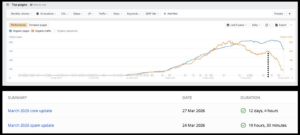
The damage doesn’t stay on the thin pages. When a core or spam update lands — roughly every quarter — Google recalculates the quality of the whole domain and pushes sites like this down as a unit. Weak blog posts drag your service pages and your homepage down with them. I’ve stared at the chart where page count climbs and organic traffic falls off a ledge in the same frame, right on an update date.
The “just rank top 10” goal is fading too. In AI Overviews, only about 38% of citations now come from pages in the top ten — the rest get pulled from deeper in the index, picked for being source-worthy rather than well-positioned. A year ago that number was 76%. Ranking #1 no longer buys you a seat in the answer. Being a primary source does.
Don’t write to match the top ten — write what isn’t there. One article with a real insight, a real case, or data nobody else has will out-earn a hundred pages of AI filler. Google indexes usefulness now, not rewrites.
Ship 5–10 pieces built on real experience, for proof rather than volume. In B2B the blog is where a buyer decides whether you actually know the work: real cases, real screenshots, real numbers, a named author with a footprint you can verify. This is where E-E-A-T becomes a technical requirement — describe a case study with nothing online to back it, and Google’s grounding checks treat it as unverified and dock your trust score. An invented case helps nobody.
And it pays off faster than people expect. I’ve had a site under a month old show up in rankings on information gain and a clean, trustworthy build alone — with an article that didn’t even aim straight at the keyword. That doesn’t happen with rewrites.
Redesign a B2B site in 2026 without treating AI discovery as a first-class requirement and you’re optimizing for a search world that’s already half gone. Around 94% of B2B buyers now use AI search somewhere in the buying process. A Head of IT asks ChatGPT for the best security platforms for a 500-person SaaS company; a VP of Marketing asks Claude which CDPs suit a PLG motion — your company is in that answer or it isn’t, and most vendors have no idea which.
The relief: there’s no dark art here. The same fundamentals carry it — original content, a crawlable and well-structured site, the actual answer near the top of each page, structured data, and a verifiable author footprint so the entity is trusted. One number worth holding onto: AI search referrals currently convert about 22% higher than traditional organic, because the assistant pre-qualified the person before they arrived. Small channel today, real one tomorrow. Build for it now, while building for it is cheap.
I’ll close on the section no agency wants to write, which is exactly why it earns the most trust. A serious conversion-focused redesign stopped being “affordable marketing” — it’s expensive, complicated and genuinely high-risk, while CTR keeps sliding as AI answers swallow the informational clicks. For some companies the most honest thing I can say is: don’t do this yet. Keep your money.
Three numbers decide it. First, what a closed deal is worth to you. Second, how many qualified leads a redesign would realistically add per month — counted from your current traffic and honest conversion deltas, not from hope. Third, the all-in cost, including the months of monitoring and iteration after launch, not just the build. Multiply the first two, set them against the third, and believe the result. If the funnel math doesn’t close, no amount of beautiful design or clever SEO changes the answer — and whoever’s promising you easy traffic is selling you something.
When the math does close, the 2026 playbook is narrow: human-plus-AI with the expertise and editing kept human, information gain over volume, a real digital footprint for your authors, a site engineered for your specific buyer — not for “looks nice.” The era of clever spam is done; fooling Google costs more now than just doing the work. What survives is what you can’t fake: real expertise, original data, real reputation. Quality stopped being a luxury. It’s the only strategy left that still works.



