A practical rebuild of evergreen content for the era of AI Overviews — with what changed and what to do instead.
I have a confession that should probably bother me more than it does. There’s a blog post I wrote for a client back in 2021 — a plain definitional guide, the “what is X” kind — and for almost three years I did basically nothing to it. It sat there pulling around 9,000 visits a month. I’d glance at it in the dashboard, see the line was flat, and move on. Easy money, I thought.
Then last year the line stopped being flat. Between roughly May and December 2025 the post lost about 61% of its traffic. I went looking for what I’d broken. I hadn’t broken anything. The post was the same. The topic was still the kind of thing people search for every single day. Google had just quietly stopped sending those people to it.
I’ve since seen the same shape on other pages, and not only mine. So I want to walk through what actually happened, because if your idea of “evergreen content” still matches what every marketing blog described in 2024 — niche beginner topics, long articles, no statistics, write it once and forget it — then you are tuning your content for a search engine that no longer works that way.
This isn’t a definition piece. It’s closer to an argument: evergreen content is still the best long-term asset you can own, but the things that used to make a piece “evergreen” are now, in a lot of cases, the things that get it ignored.
If you read enough marketing advice from a few years ago, the evergreen checklist was remarkably consistent. It went something like this:
None of that was stupid. It made sense for a search results page with ten blue links, where a thin but well-titled article could win a click on the strength of the headline alone. That page is mostly gone now. Google’s AI Overviews — the answer box at the top — show up on something like a third to nearly half of all searches, depending on whose 2026 data you trust and what kind of query you’re counting.
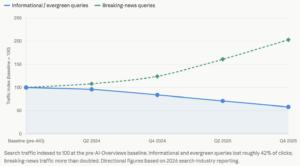
And here’s the part that stung when I read it. A search industry report from early 2026 looked at where the traffic losses landed after AI Overviews rolled out, and they weren’t spread evenly. Informational and evergreen queries — the exact “what is” and “how to” stuff the old checklist tells you to write — were down around 42% against the pre-Overviews baseline. Breaking news, meanwhile, was up. The losses concentrated almost entirely on the kind of content I’d spent years telling clients to invest in.
The mechanism behind it is simple once you see it. When a search engine hands back ten links, a shallow definitional article can still earn a click. When an AI engine writes one answer instead, your article isn’t competing for a click anymore — it’s competing to be the source the model pulls from while it writes that answer. And the model doesn’t reach for thin beginner content. It reaches for whatever page is the most specific, the most verifiable, the easiest to quote.
So the old checklist was optimizing for a human beginner skimming a list. The new reality rewards being quotable by a machine that’s answering that beginner for you. Those two documents are not the same. Sometimes they’re opposites. Let me go through it.
The logic was that numbers date a piece. A 2023 stat looks old by 2025. Fair enough on its face. But there’s a fairly well-known study on this now — it came out of Princeton and a few collaborating groups, and it tested nine different ways of tweaking content to see which ones made AI engines more likely to cite it. They ran it across 10,000 queries.
Adding statistics was the single most effective thing they tested. It lifted a page’s visibility in AI answers by roughly 40%. Citing your sources did about as well. Adding a real expert quote landed somewhere around 28%.
The four tactics that did nothing — or actively hurt — were keyword stuffing, simplistic “make it easier to read” rewriting, padding the word count, and laying on persuasive language. Which is, more or less, a description of the house style of old evergreen content: long, simple, padded, keyword-tuned, and carefully stripped of numbers.
There was a second finding I think about a lot. The lower-ranked a page was, the more these tactics helped it. If you’re already the dominant result, factual density is a nice-to-have. If you’re sitting at position seven, it’s the biggest lever you’ve got.
The fix isn’t to keep numbers out because they age. It’s to cite a specific number precisely, attribute it, and then keep it current. “A 2025 study found 95% of web pages lose at least half their organic traffic within three years” — that’s a clean, quotable, checkable claim. “Most content loses traffic over time” is not. An AI engine will lift the first one into an answer and walk straight past the second.
The old advice mixed up length with depth. A 3,000-word beginner article that circles the same three ideas is long. It is not deep. AI retrieval systems — Perplexity and Google’s Overviews especially, since they pull pages in real time — judge a page heavily on how it opens.
One 2026 analysis I came across, looking at where AI engines pull their citations from, found that about 44% of citations come from the first third of the article. Pages that put a strong, claim-heavy point up top got cited roughly twice as often as pages that didn’t.
That’s bad news for the classic evergreen structure, which buries the actual answer under a warm-up paragraph — the “with plants gaining popularity these days” opening — so the reader has to scroll. That scroll-bait intro is now a liability. The first 150 to 200 words need to answer the question outright. The length of the rest has to be earned with real depth: edge cases, the bits that contradict the simple version, worked examples. Not a longer runway before the takeoff.
Old rule: put a publish date on for credibility, then leave it frozen forever. In an AI-Overviews world that’s roughly the opposite of what you want. These systems weight recent content for anything with a time-sensitive angle, and far more queries have that angle than people assume. A visible “last updated” date, current-year numbers, and fresh examples now beat a frozen page on the identical topic.
This is the thing that got my 2021 post. The phenomenon has a name — content decay — and that 95% figure I quoted earlier is exactly it: most pages shed half their traffic or more inside three years. Evergreen content isn’t immune. It just decays slower, which is precisely what lulled me into ignoring it. The topic stayed evergreen. The examples, the stats, the tools I’d named inside the article did not. One reference to a product that no longer exists and the whole page starts reading as out of date — to the algorithm and to the human both.
This is the one piece of old advice I’d keep. But not because trends “expire.” It’s because evergreen content has a specific job now: it’s the stable floor under your traffic. There’s long-running data from HubSpot on what they call compounding posts — pieces whose traffic grows over time instead of spiking and fading. Only around 10% of posts ever become one. Those few carry a wildly outsized share of the traffic and the leads.
Trending content gives you a spike. Evergreen content raises the floor. You want both. The mistake is treating them as the same project.
Here’s the definition I actually use with clients these days. Evergreen content is built on a durable question, but assembled out of parts that are specific, kept current, and easy for a machine to extract. Three things — and the old definition either ignored or contradicted all of them.
A durable question, not durable text. “What is SEO” gets searched as much in 2026 as it did in 2020. That demand is the evergreen part. The answer, though, has to move as the field moves. Evergreen is a property of the topic plus a habit of maintenance — not a fixed quality the document keeps forever.
Quotable parts. AI engines lift content in chunks. So every real claim should stand on its own — specific, attributed, liftable. “Increased revenue 47% over six months, per the client’s Q3 dashboard” is a chunk an engine can take. “Significantly improved performance” is not. This is why case studies with hard numbers crush vague capability claims. There’s late-2025 data showing data-rich pages get cited several times more often than directory-style listings, and that matches what I see.
Structure a machine can read. Headings phrased as questions, a clear hierarchy, plain definitions, comparison tables, step lists. An engine reads structure like a map. A beautiful unbroken wall of prose is, to a retrieval system, hard to parse — and hard to parse means rarely cited.
Theory is cheap, so let me tell you what happened when I took my own advice and rebuilt that 9,000-visit guide. I treated it as a test, more or less, over one quarter.
The changes themselves were not dramatic. I rewrote the opening so it answered the core question in the first paragraph instead of the fourth. I went through and added real, sourced numbers everywhere the old draft had hand-waved with phrases like “many businesses find that.” I swapped three of those generic paragraphs for three short case studies with actual figures in them. Two prose sections became a comparison table and a numbered procedure. I added a “last updated” line and a one-sentence note on what had changed. And I tightened the internal links so the page sat inside a cluster of four related posts instead of floating alone.
The good news came slower than I wanted. It took about ten weeks before the page started showing up as a cited source inside AI Overviews for a few of its target queries. That mattered more than the traffic number, honestly — being cited inside the answer box, even when the box answers most people without a click, still earns a measurable click-through bump over the competitors who aren’t cited. Year-over-year traffic stopped falling and crept slightly positive. Against a 95%-decay baseline, “slightly positive” is a genuine win, even if it doesn’t feel like one in the moment.
Now the part I’d rather skip but shouldn’t, because it’s the part I learned from.
My first rewrite of the introduction overcorrected, hard. I’d just read the study about factual density, so I front-loaded the intro with stat after stat after stat — something like five numbers in the first ninety words. It read like a briefing document. I was pleased with it. Then I watched the analytics over the next two weeks and the average time on page dropped by a noticeable chunk; I don’t have the exact figure in front of me but it was the kind of drop you don’t argue with. The AI engines, as far as I could tell, were perfectly happy with it. Human readers bounced. I had to go back in and thread an actual voice back through that opening — keep the numbers, lose the briefing-document cadence. The lesson I took: optimizing for machine extraction and optimizing for a person reading are not the same axis, and if you crank one to the maximum you will quietly wreck the other.
The second mistake was more conceptual. I’d decided to make the whole article evergreen, including a section recommending specific tools. Tools move too fast for that. Within a quarter that section was already wrong in two places — a pricing tier had changed, one tool had been folded into another product. I ended up pulling it out into its own separate page with its own update schedule. Which circles back to the one true thing in the old checklist: not everything can be evergreen. My error was assuming the line ran between “evergreen” and “seasonal.” It actually runs between the stable and the fast-moving parts of the same article. I’d put a fast-moving part inside an evergreen frame and then been surprised when it rotted.
If evergreen content decays, then “publish and forget” isn’t a strategy. It’s just a loss you’ve agreed to take later. Here’s the routine I run now. It’s deliberately boring, because boring routines are the ones that actually get done.
Audit on a fixed schedule, but let alerts override it. Every six to twelve months as the baseline pass. But if a page drops more than about 20% month-over-month, I refresh it then and there rather than waiting for the calendar. Most tools wired into Search Console can flag that drop for you automatically.
Refresh, don’t rewrite, unless you have to. Small targeted updates — swap a stale number, fix a dead link, add a current example — hold rankings far more efficiently than periodic full rewrites. Updating an existing URL also keeps the page’s history working for you. That’s why a refreshed post often jumps a healthy amount in traffic: it already has equity a brand-new page hasn’t earned yet.
Prune without sentiment. Pages you can’t make genuinely useful should be merged or removed, not left to rot. Every weak page drags on the authority of your strong ones. Cutting the dead weight is itself a maintenance act.
Measure year-over-year, not month-to-month. For an evergreen page the most honest single metric is this November against last November. If it holds or beats, the page is winning — it survived a year of newer competition and a more aggressive AI answer layer. I pair that with two others: how many distinct long-tail keywords the page ranks for, and whether it’s showing up as a citation in AI Overviews or Perplexity. That last one barely registers in a normal traffic chart, which is exactly why it’s easy to miss.
Evergreen content isn’t dead. You’ll see the “it’s dead” take a lot — it got common through 2025 — and it’s wrong, but it’s wrong in a way that’s worth understanding. What died is a particular style: thin, padded, number-free, frozen, beginner-only content that used to win clicks because it ranked fifth on a page of ten links. That style is now close to invisible, and the post-Overviews data shows just how invisible.
What replaces it is harder, and frankly more interesting to do. Evergreen content in 2026 is a durable question, answered with specifics you can cite, structured so a machine can lift it, and maintained on a real schedule. It still does what the old playbook promised — it compounds, it raises your traffic floor, it builds authority while you sleep. It just doesn’t do any of that for free anymore.
The people who keep their evergreen rankings over the next couple of years won’t be the ones who published the most articles. They’ll be the ones who treated each evergreen page as something alive — dated, sourced, structured, audited, and occasionally admitted to be wrong and rebuilt. I’d argue that willingness to go back and fix what you got wrong is the most evergreen skill there is. It took me a 61% traffic drop to actually start practising it.
If your evergreen content has lost ground over the past year, the place to start isn’t a guess — it’s a year-over-year audit page by page. That’s unglamorous, measurable work, and it’s the kind of thing worth handing to a team that does it for a living.



